QUIET WITHIN BY SIONA THACKER
✦ Can a painting express what words cannot?
This collection of original oil paintings by Siona Thacker explores the unseen dimensions of spirituality through the language of art. Inspired by the wisdom of Kabbalah, these works reflect themes such as the soul, the Tree of Life, the Ten Sefirot, Divine light, consciousness, creation, and the spiritual journey of human existence.
Rather than illustrating Kabbalistic ideas literally, each painting invites the viewer into a world of symbolism, contemplation, and inner reflection. Through color, form, and imagination, these works seek to express spiritual realities that cannot always be conveyed through words alone.
Quiet Within | Spiritual Reflection • Kabbalah • Inner Awareness
✦ The Land of Israel – The Living Body of Creation
Why has the Land of Israel been regarded as the spiritual heart of the world for thousands of years?
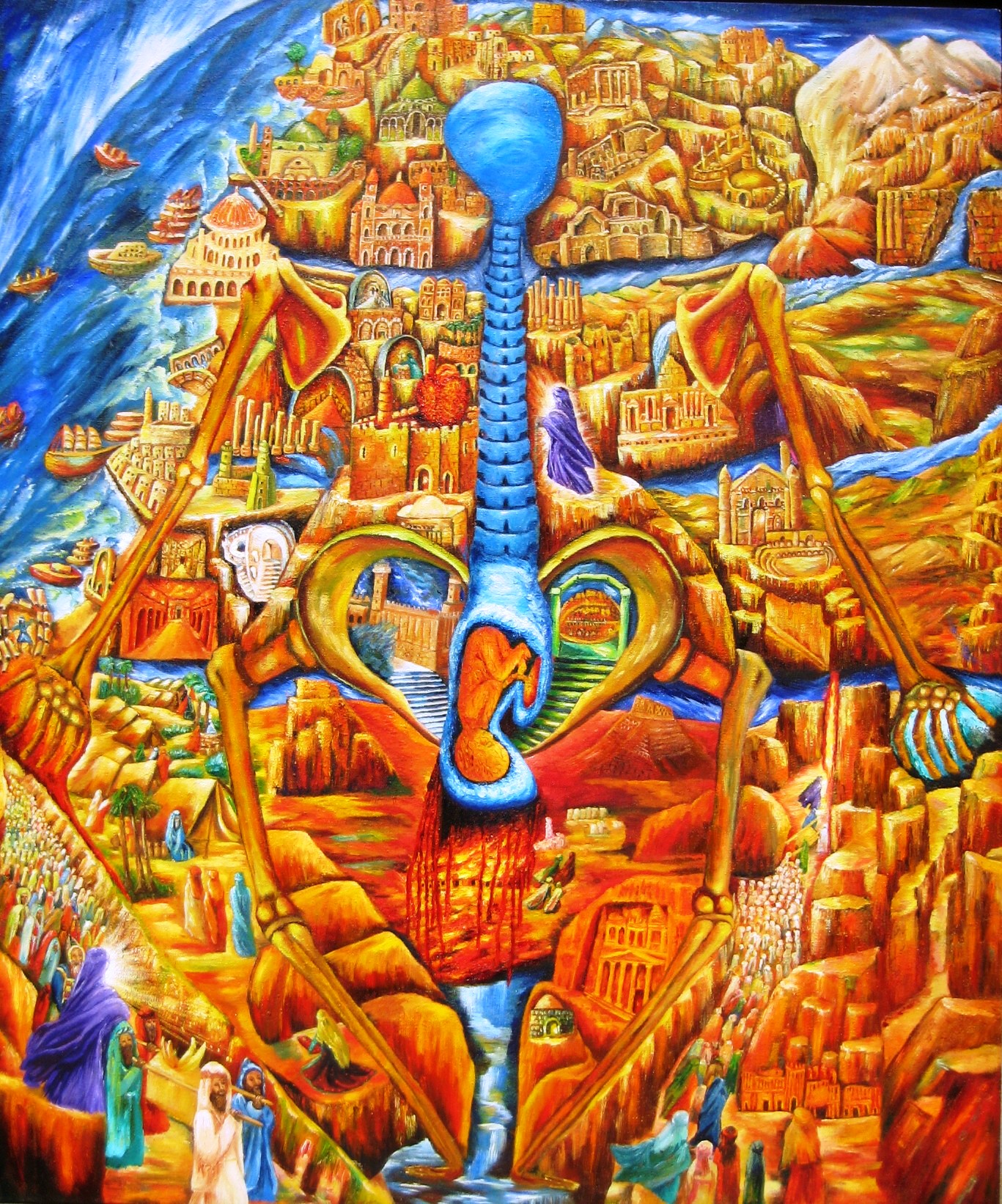
This original oil painting presents my artistic and Kabbalistic interpretation of the Land of Israel as a living spiritual body. Inspired by the teachings of Kabbalah, the composition portrays the land as a reflection of the human form, expressing the profound connection between humanity, creation, and Divine consciousness.
At the center of the painting, the human body is woven into the landscape, symbolizing the idea that the spiritual and physical worlds are interconnected. In my artistic vision, Jerusalem represents the heart, from which Divine vitality flows throughout the land. The northern region, including Safed, symbolizes higher consciousness and wisdom, while the southern regions represent the body’s foundation and movement.
The painting is inspired by the Kabbalistic understanding that the Land of Israel holds a unique spiritual role. According to Jewish tradition, Jerusalem. According to Kabbalistic and Jewish tradition, the Temple Mount is regarded as the spiritual center from which Divine blessing flows into the world. This idea is expressed here through symbolic pathways flowing outward from the heart of the land.
Historic cities, biblical landscapes, mountains, deserts, rivers, and sacred sites are woven together into a single symbolic vision, expressing the unity of the Land of Israel, the human soul, and the Divine order of creation.
For visitors interested in exploring these ideas in greater depth, I have also included a video lecture dedicated to the spiritual significance of the Land of Israel. The lecture expands on many of the Kabbalistic concepts expressed in this painting, including the unique role of the Land of Israel, Jerusalem, the Temple Mount, and their spiritual connection to creation and human consciousness. You can find the lecture on the Videos page of this website.
✦ The Ten Sefirot
The Thirty-Two Paths of Wisdom
Can the entire universe be understood through ten spiritual forces?
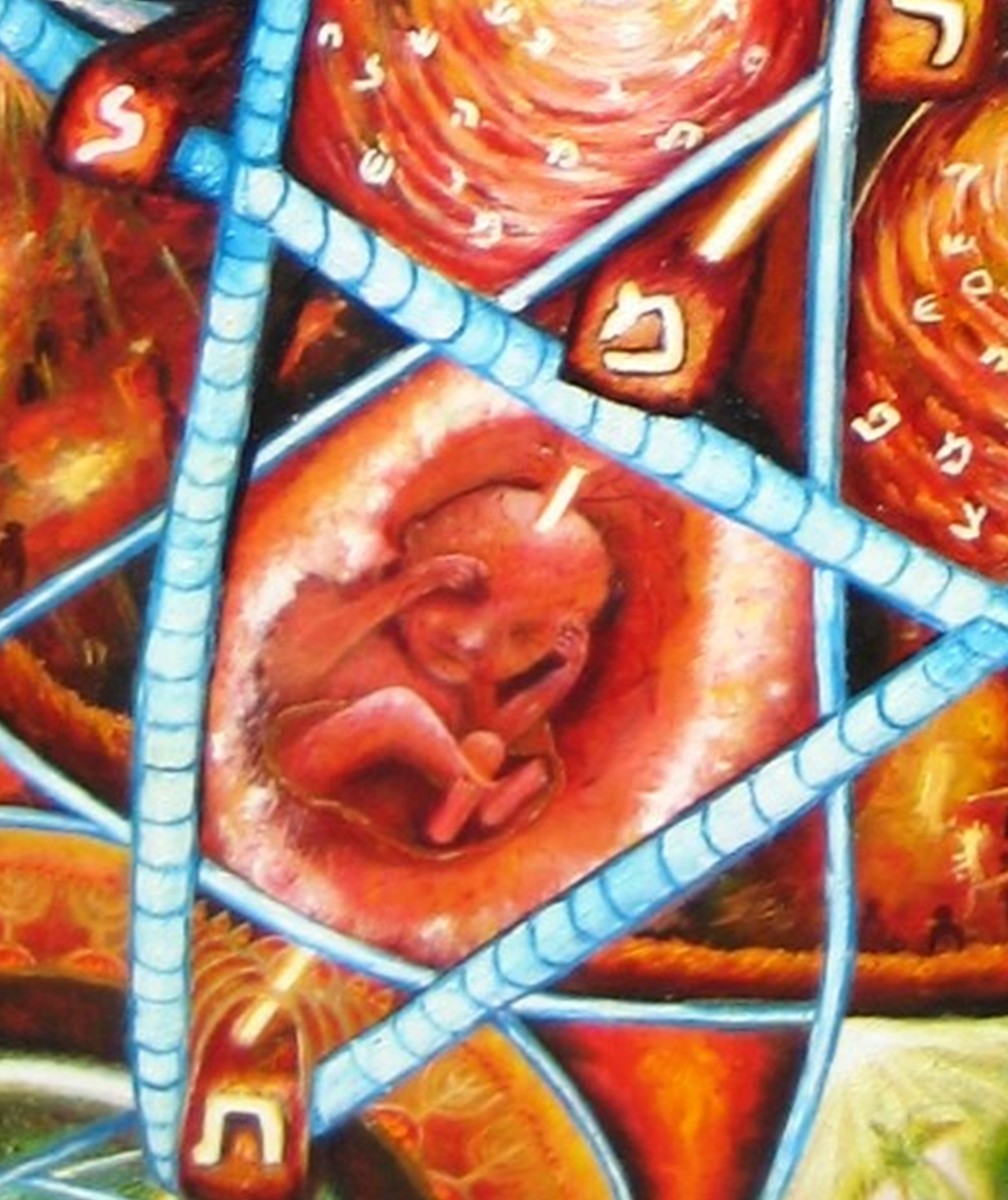
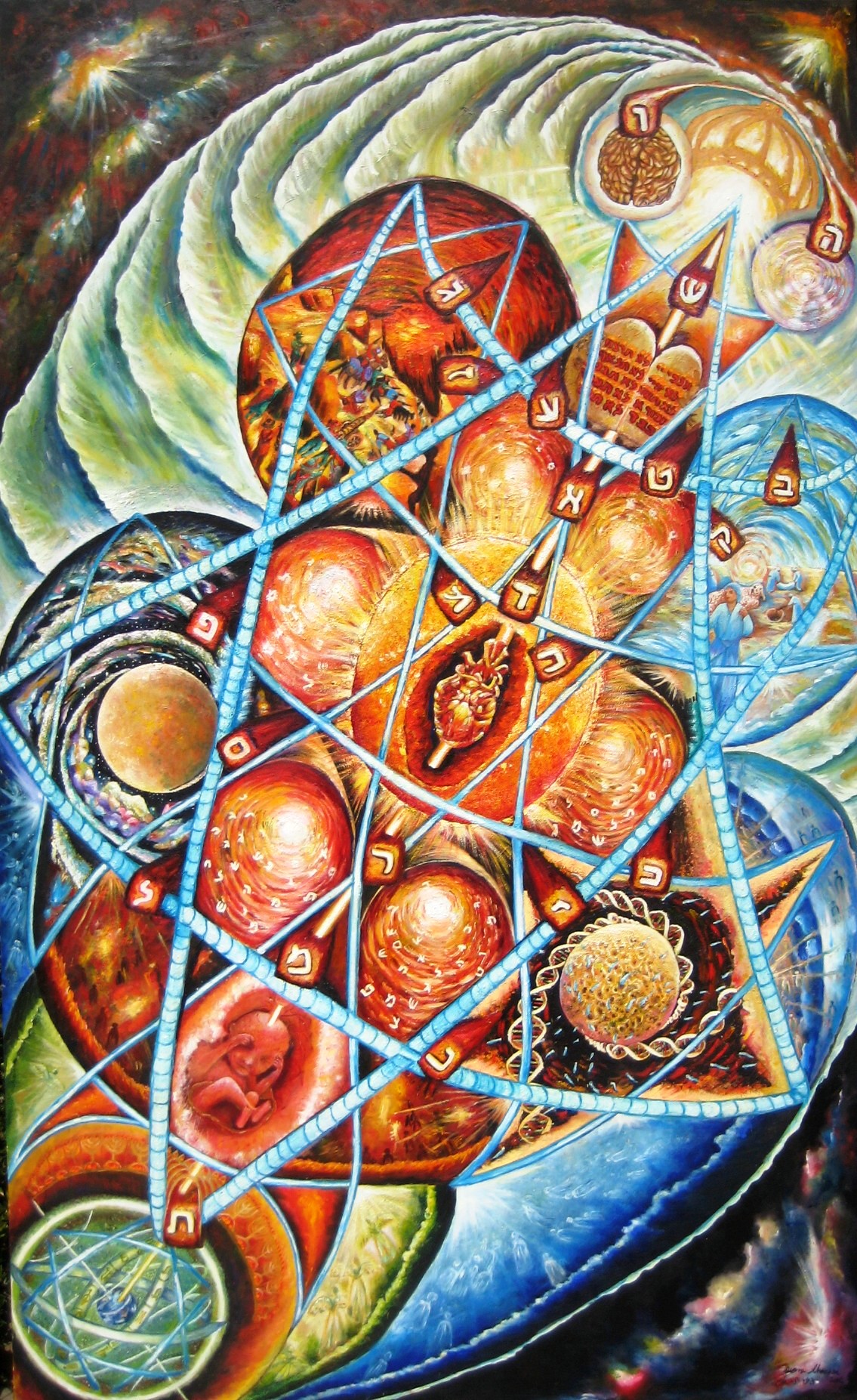
Inspired by the Kabbalistic concept of the Ten Sefirot – the ten Divine emanations through which Infinite Light is revealed and creation unfolds. Together with the Twenty-Two Hebrew letters, they form the Thirty-Two Paths of Wisdom described in the Sefer Yetzirah.
The Hebrew letters woven throughout the painting symbolize, in my artistic interpretation, the spiritual alphabet of creation. Just as DNA carries the code of physical life, the Hebrew alphabet is presented here as the symbolic code through which Divine wisdom is expressed in the universe.
At the heart of the composition, thirteen interwoven Stars of David represent the harmony between the spiritual worlds, the order of the cosmos, and earthly existence. Inspired by the Kabbalistic principle “As above, so below,” The painting reflects the Kabbalistic understanding that the spiritual worlds and the physical world are interconnected, with higher realities expressed through the order of creation below.
Symbols including the human heart, the embryo, the Tablets of the Covenant, celestial spheres, and Divine light express the continuous journey of the soul from creation toward spiritual awakening and unity with its Divine source.
✦ The Seven Earths
Could there be hidden worlds within creation that are invisible to the physical eye?
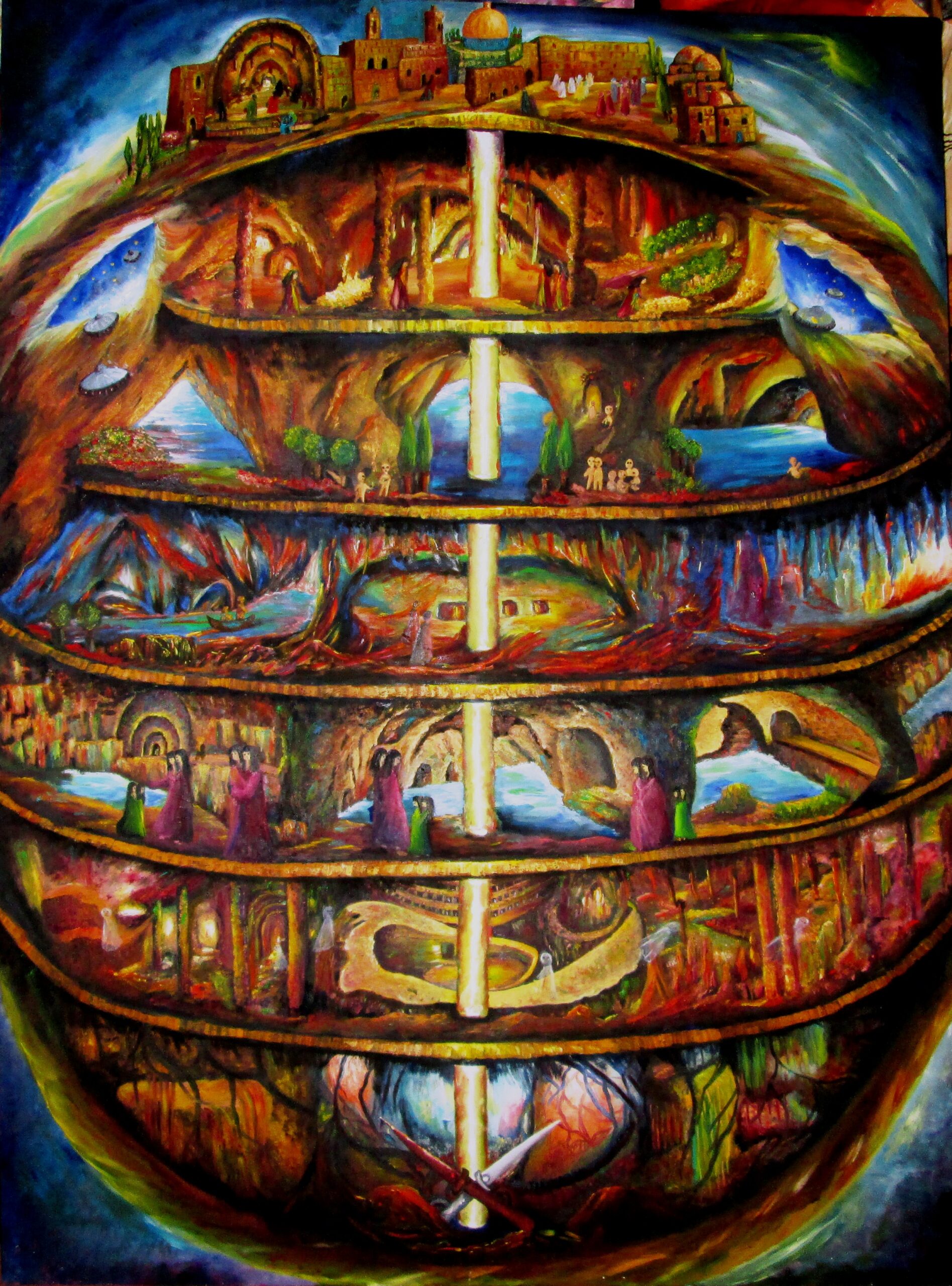
This original oil painting is inspired by the teachings of the Zohar and Kabbalah and presents a symbolic vision of the Seven Earths (Sheva Aratzot) that, according to Kabbalistic tradition, exist within the Earth. Rather than depicting a physical or scientific model, the painting illustrates a spiritual map of hidden realms described in the mystical literature of Judaism.
The Zohar describes seven interconnected worlds known as Eretz, Adamah, Gai, Neshiah, Tziyah, Arka, and Tevel. Each possesses its own spiritual qualities, inhabitants, and unique purpose within the Divine order of creation. In this painting, every level represents one of these inner worlds, connected through a central column of Divine light that symbolizes the continuous flow of spiritual life throughout all existence.
At the highest level stands Jerusalem, symbolizing the holiest point within the earthly realm and the meeting place between Heaven and Earth. From a Kabbalistic perspective, Jerusalem represents the spiritual center from which Divine influence is revealed to creation.
The composition also reflects one of the recurring patterns in Kabbalah-the sacred number seven. The Seven Earths correspond symbolically to the seven lower Sefirot and parallel many other spiritual structures found throughout Jewish tradition, including the Seven Heavens, the seven days of Creation, the seven-day week, the seven weeks of the Counting of the Omer, the Sabbatical cycle (Shemitah), and the Jubilee (Yovel).
This painting is an artistic interpretation of these ancient mystical teachings, inviting the viewer to contemplate the hidden dimensions of creation and the spiritual unity that connects every level of existence.
✦ The Ten Commandments – Channels of Divine Light
What if the Ten Commandments are more than laws-and form the spiritual blueprint of creation?
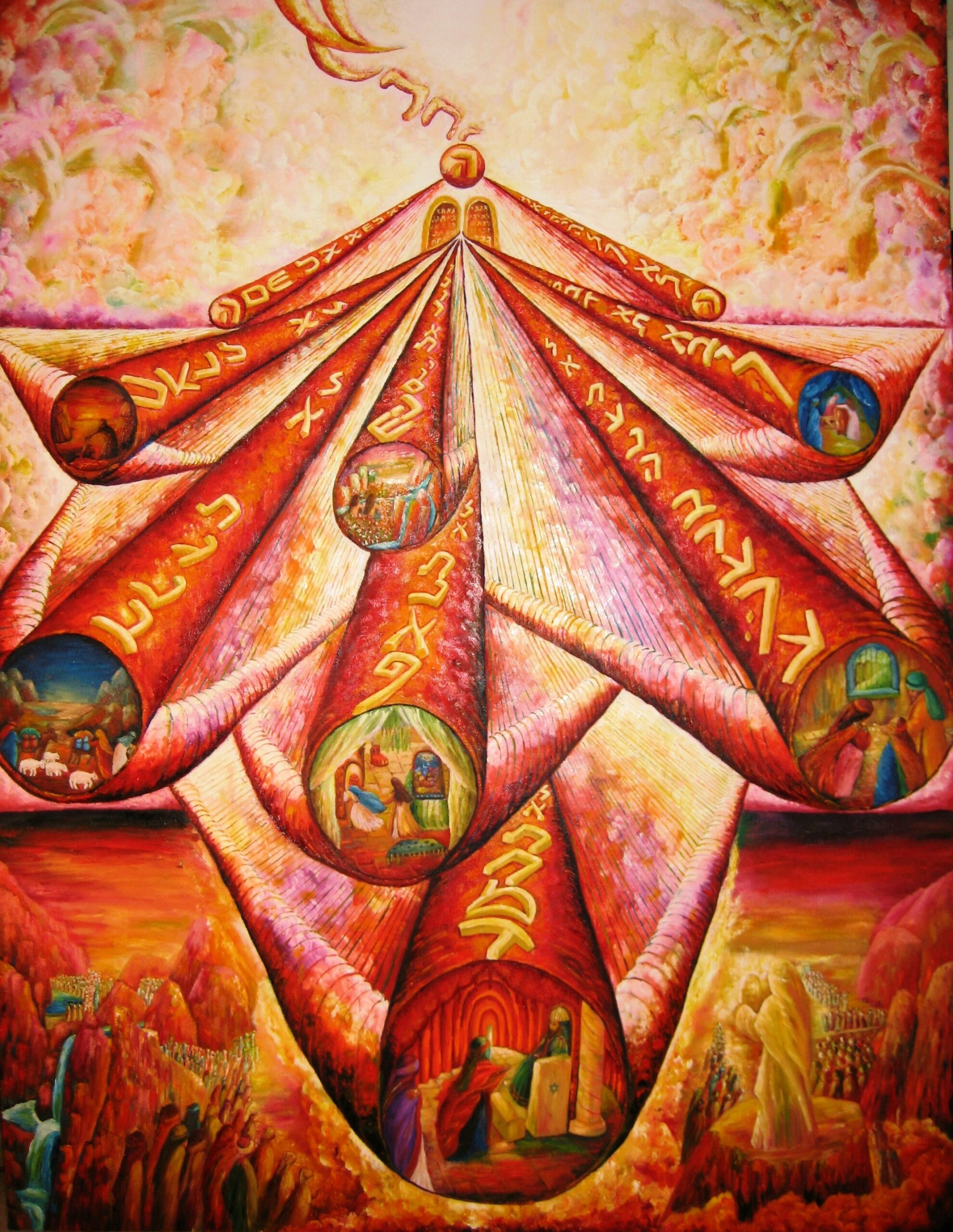
This original oil painting presents a symbolic Kabbalistic interpretation of the Ten Commandments (Aseret HaDibrot). Rather than depicting the tablets alone, the painting portrays each commandment as a spiritual channel through which Divine wisdom and blessing continually flow into creation.
The ten luminous scroll-like channels represent the Ten Commandments revealed at Mount Sinai. In Kabbalistic thought, the number ten reflects the Ten Sefirot-Keter, Chokhmah, Binah, Chesed, Gevurah, Tiferet, Netzach, Hod, Yesod, and Malkhut-the ten Divine attributes through which God’s presence is revealed and sustained within the universe. The painting symbolically connects each commandment with one of these Sefirot, expressing the harmony between Divine law and the spiritual structure of creation.
Within each channel appears a scene from the Torah, illustrating the deeper meaning of the commandment and its living expression throughout the history of the Jewish people. The composition also reflects the traditional association between the tribes of Israel and the spiritual order revealed through the Torah.
At the base of the painting stands Mount Sinai, representing the moment of Divine revelation that marked the beginning of Israel’s covenant with God. Above, angels watch over the unfolding of creation, symbolizing the continuous connection between the heavenly and earthly realms.
The painting expresses the idea that the Torah is not only a historical event or a collection of commandments, but an eternal source of Divine light that continues to illuminate the world through every generation.
✦ The Spiritual Menorah – Above and Below
Can the Menorah be understood as a spiritual map of creation
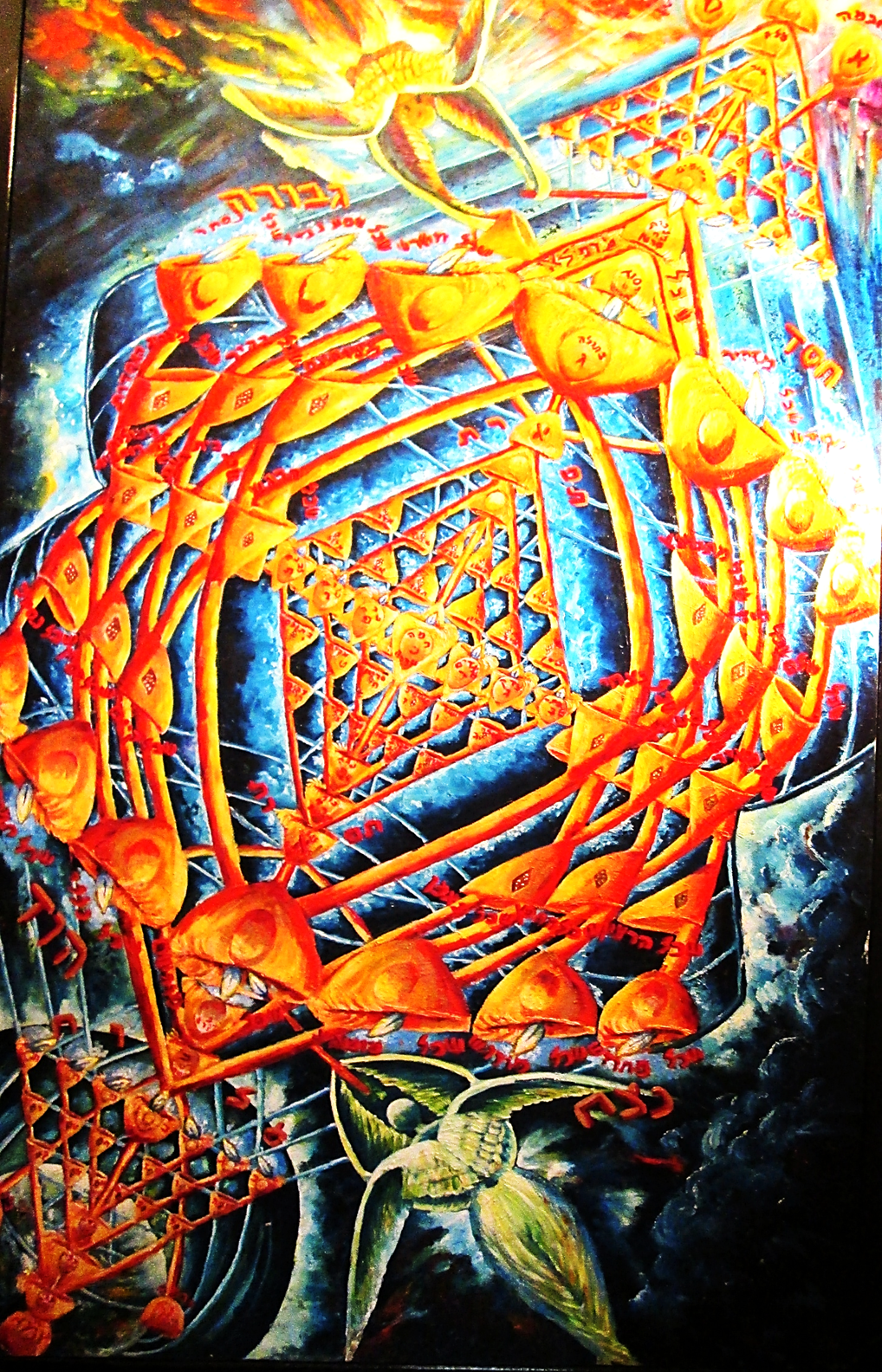
This original oil painting presents my artistic and Kabbalistic interpretation of the Menorah as a spiritual structure reflected within the physical world. The composition brings together an earthly Menorah and its corresponding spiritual form, expressing the idea that visible reality is rooted in higher, unseen dimensions.
The seven branches symbolize the recurring pattern of seven throughout creation and Jewish mystical thought. They reflect the seven lower Sefirot-Chesed, Gevurah, Tiferet, Netzach, Hod, Yesod, and Malkhut-as well as the seven heavens, celestial spheres, lands, and other sacred cycles through which creation is ordered. Kabbalistic teachings commonly associate the seven lights of the Menorah with these seven Divine attributes.
In my artistic vision, an additional central channel represents the holiness of Jerusalem, the spiritual point that unites and elevates all the levels. When the spiritual and physical menorahs meet, their intersecting forms create one great Star of David, symbolizing the harmony between the worlds above and the world below.
The interconnected branches, Hebrew letters, and pathways also represent the Thirty-Two Paths of Wisdom described in Sefer Yetzirah: the Ten Sefirot together with the Twenty-Two foundational Hebrew letters. Here they form a living network through which Divine wisdom and spiritual vitality flow into creation.
The oil and light symbolize Divine wisdom, illumination, and the spiritual abundance that descends through the Sefirot. The central branch represents balance and unity, gathering the separate forces into a single harmonious source of light. The birds and angelic figures surrounding the composition suggest spiritual guardianship and the movement of consciousness between different levels of existence.
Through repeated menorahs, sacred geometry, Hebrew letters, and luminous pathways, the painting expresses the principle that the spiritual and physical dimensions of creation correspond to one another: what is revealed below has its root above, and every visible form carries an unseen spiritual source.
✦ Israel – Past, Present, and Eternal Hope
Can a nation carry thousands of years of history while continuing to build its future?
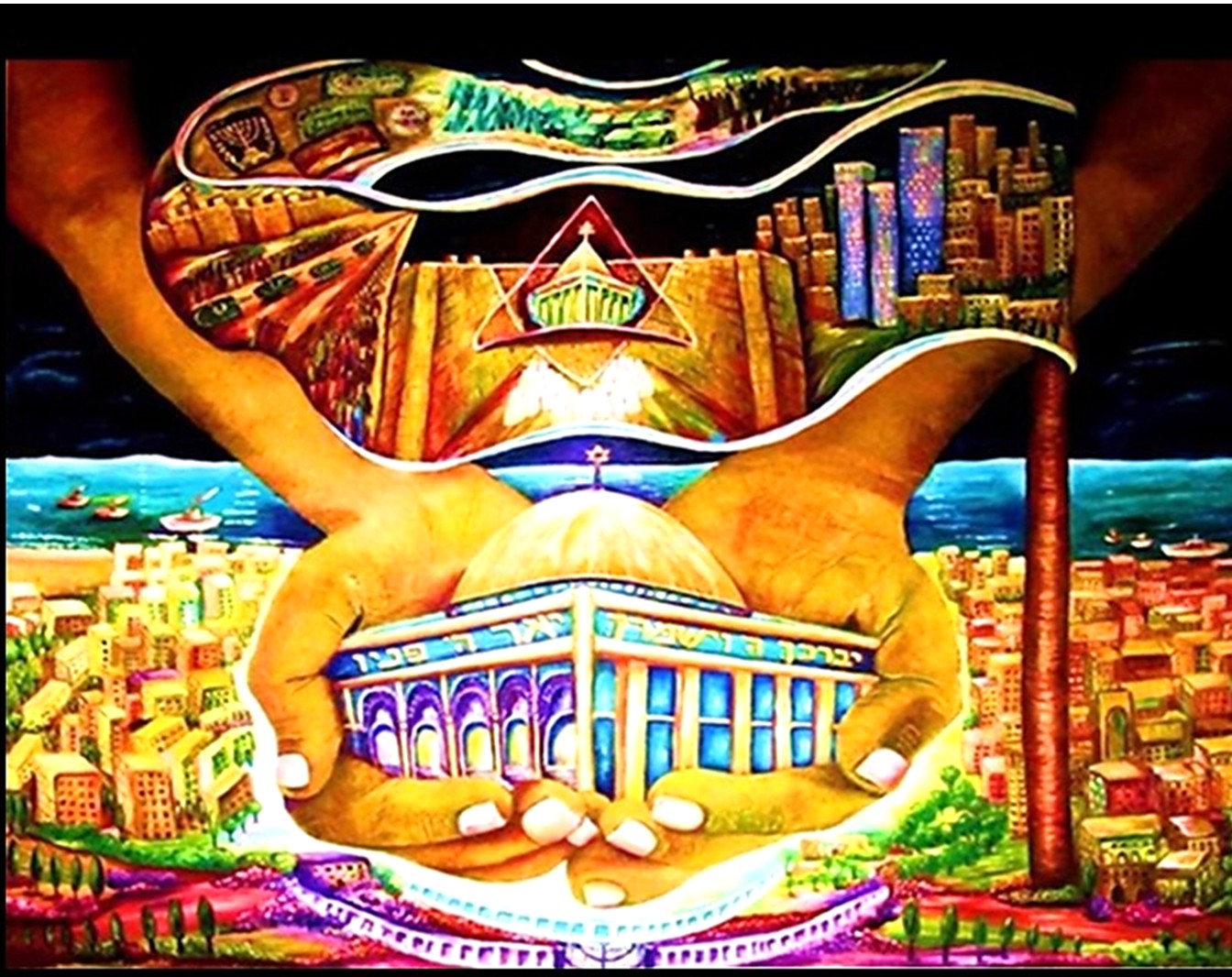
This original oil painting symbolizes the enduring bond between the Jewish people, the Land of Israel, and Jerusalem. At its center, two hands gently hold the Holy Temple, representing faith, responsibility, and the hope that has accompanied generations throughout Jewish history.
Flowing above the Temple is a ribbon depicting milestones in the history of Israel-from the ancient Kingdoms of Israel and Judah, through periods of exile and return, to the establishment of the modern State of Israel in 1948 and its remarkable growth into a vibrant, innovative nation.
Surrounding the Temple is the modern city, representing the transformation of a young country that began with limited resources, agricultural settlements, and communities built on sand dunes into one of the world’s leading centers of science, technology, medicine, agriculture, and innovation. Despite its small size, Israel has become internationally recognized for its achievements while preserving its ancient spiritual heritage.
In Jewish tradition, Jerusalem is regarded as the spiritual heart of the nation and the location of the First and Second Temples. For centuries, Jewish prayers have expressed the hope for Jerusalem’s peace and the restoration of its spiritual center. The Temple shown in this painting therefore represents not only a historical structure but also a symbol of unity, faith, and continuity throughout generations.
The hands holding the Temple express both protection and responsibility, reminding us that every generation carries the legacy of the past while shaping the future. The painting invites viewers to reflect on the extraordinary journey of the Jewish people-from ancient history, through exile and return, to the continued development of the State of Israel and the enduring hope for peace, renewal, and spiritual fulfillment.
✦ The Ten Sefirot – Channels of Divine Light
How does the Infinite become present within the finite world?
According to Kabbalah, the Infinite Divine Essence (Ein Sof) is beyond human comprehension. The Ten Sefirot are not separate beings, but ten channels or attributes through which Divine Light is revealed and continuously sustains creation.
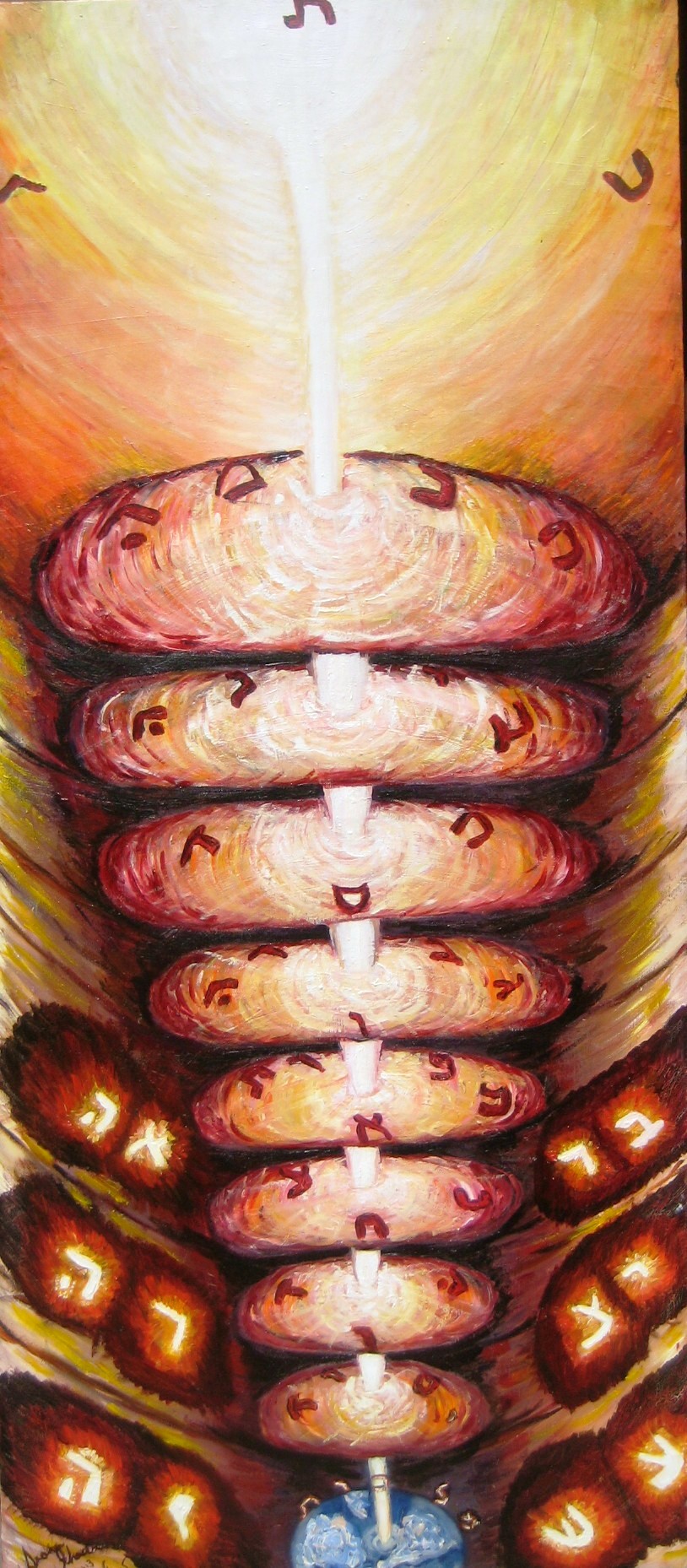
This abstract oil painting portrays the spiritual flow descending from the highest source through the Ten Sefirot, represented as luminous layers connected by a central stream of light. Each level symbolizes a stage in the unfolding of Divine energy as it passes from the hidden spiritual realms into the physical world.
The Hebrew letters surrounding the composition remind us that, according to Sefer Yetzirah, the twenty-two Hebrew letters are the spiritual building blocks of creation. Together with the Ten Sefirot, they form the Thirty-Two Paths of Wisdom, through which Divine wisdom is expressed throughout the universe.
The vertical beam of light represents the uninterrupted connection between Heaven and Earth, while the expanding circles suggest the continual transmission of life, consciousness, and spiritual influence. The painting expresses the Kabbalistic principle that every level of existence is interconnected, and that what exists in the higher spiritual worlds is reflected, in different form, within the physical world.
Rather than illustrating physical objects, this work invites the viewer to contemplate the invisible structure of creation and the continuous relationship between the Creator and all existence.
✦ The Holy Temple – Where Heaven Meets Earth
Why was the Holy Temple considered the spiritual center of the world?
According to Jewish tradition and Kabbalah, the Holy Temple in Jerusalem was far more than a magnificent building. It represented the place where the Divine Presence (Shechinah) was revealed most openly, serving as the spiritual center of the world and the meeting point between Heaven and Earth.
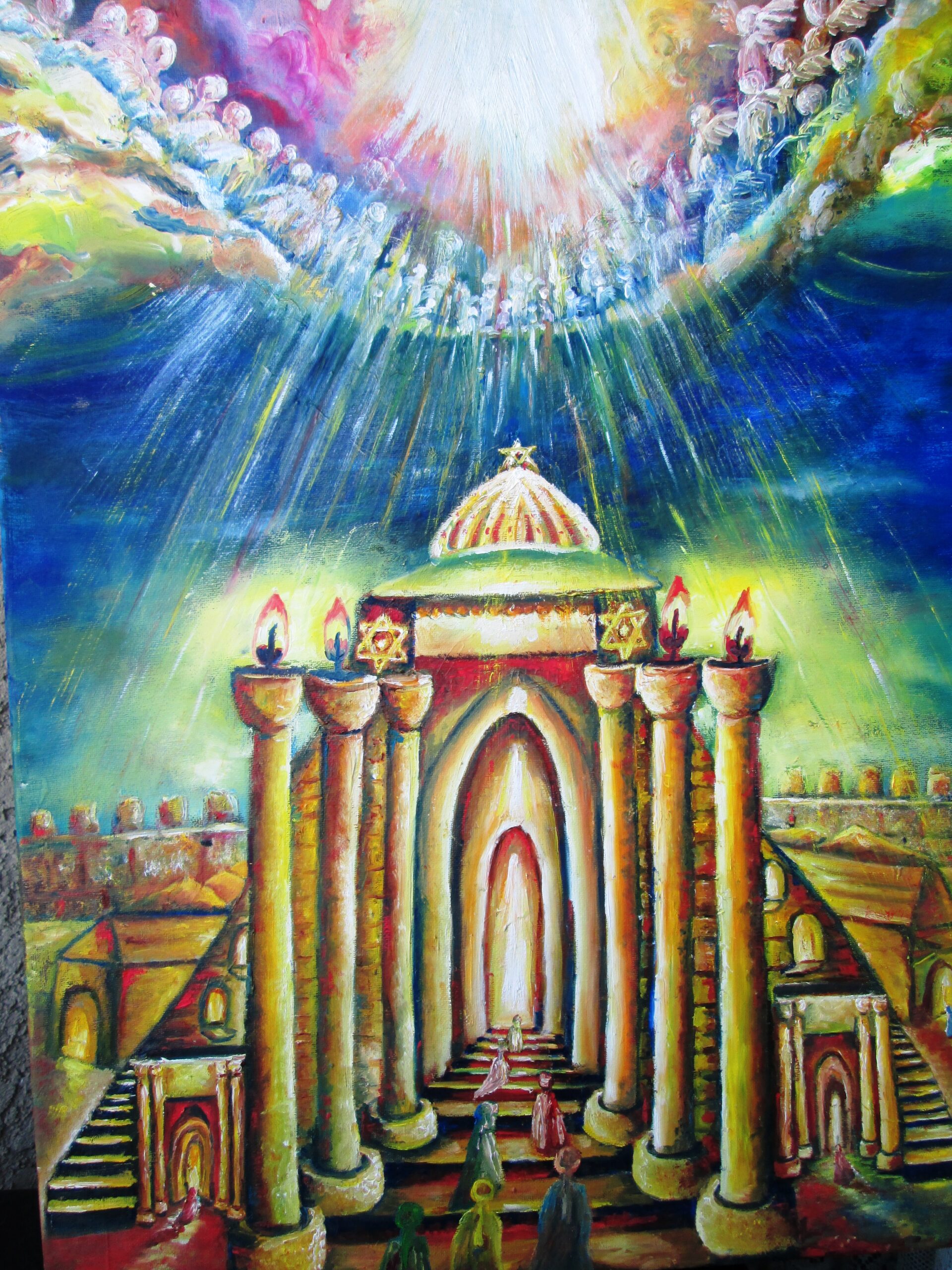
This original oil painting portrays the Temple bathed in radiant light descending from above. The heavenly light symbolizes the continuous flow of Divine blessing, while the angels surrounding the heavens represent the spiritual realms witnessing the connection between the Creator and humanity. In Kabbalistic thought, angels are not independent beings but messengers carrying out the Divine will and participating in the harmony of creation.
The worshippers ascending the Temple steps symbolize humanity’s spiritual journey toward holiness. Every step reflects the desire to draw closer to God through prayer, gratitude, repentance, and inner refinement. The Temple therefore becomes both a physical destination and a symbol of the soul’s ascent.
Jewish tradition teaches that Jerusalem is the spiritual heart of the Land of Israel, and the Temple Mount is its holiest point. Kabbalistic sources describe it as the place from which Divine abundance flows into the world, connecting the higher spiritual worlds with earthly existence.
Rather than depicting only a historical sanctuary, this painting expresses the timeless hope for spiritual unity, peace, and the restoration of a world illuminated by Divine Presence.
✦ The Two Angels – The Choice Between Good and Evil
Who are the angels that accompany every person throughout life?
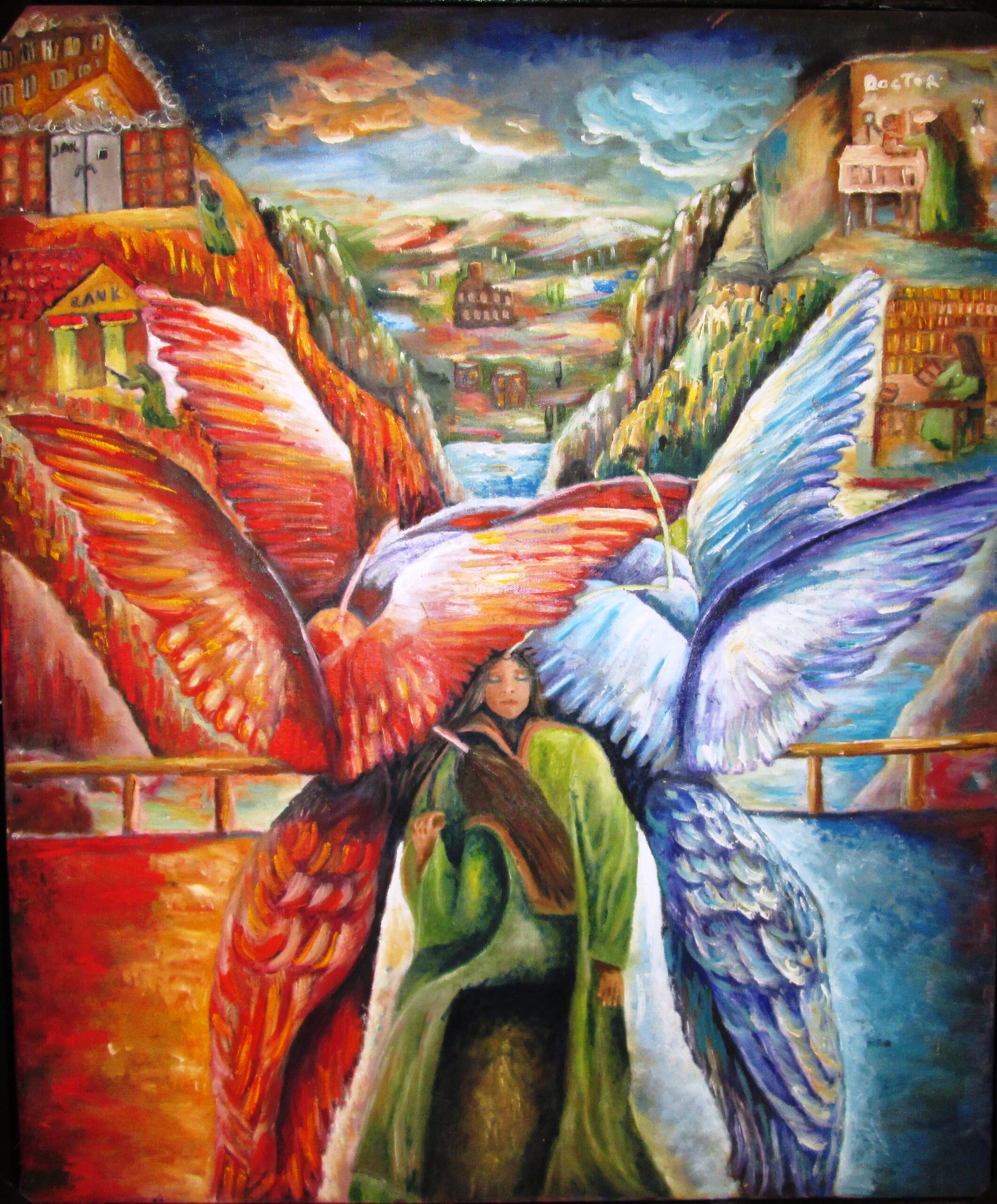
According to Jewish tradition and Kabbalistic teachings, every person is accompanied throughout life by spiritual forces that reflect the constant choice between good and evil. This painting symbolizes the inner struggle that exists within every human being and the freedom to choose one’s path.
The angel on the right represents the qualities of kindness, compassion, and spiritual growth. The angel on the left represents judgment, temptation, and the challenges that test a person’s character. Rather than forcing a person’s decisions, these opposing spiritual influences reflect the moral choices that accompany every stage of life.
In Kabbalistic literature, the archangel Michael is associated with the right side and the attribute of Chesed (loving-kindness), while Gabriel is associated with the left side and the attribute of Gevurah (judgment and discipline). The Zohar also speaks of angels accompanying a person and describes spiritual forces on both the right and the left.
According to the teachings of Rabbi Isaac Luria (the Ari), the soul is accompanied and protected by heavenly forces throughout life. During sleep, the soul ascends to the spiritual worlds while angels continue to guard and accompany it, emphasizing the continuous connection between the physical and spiritual dimensions.
The valley stretching into the distance symbolizes the journey of life. Every decision, thought, and action determines which path a person strengthens within themselves. The painting therefore reminds us that although both influences are present, the ultimate choice always remains in human hands.
✦ The Journey of the Soul
What happens to the soul after it leaves the physical world?
According to Jewish tradition and Kabbalistic teachings, death is not the end of existence but the beginning of a new spiritual journey. While the body returns to the earth, the soul continues its existence and ascends toward its Divine Source.
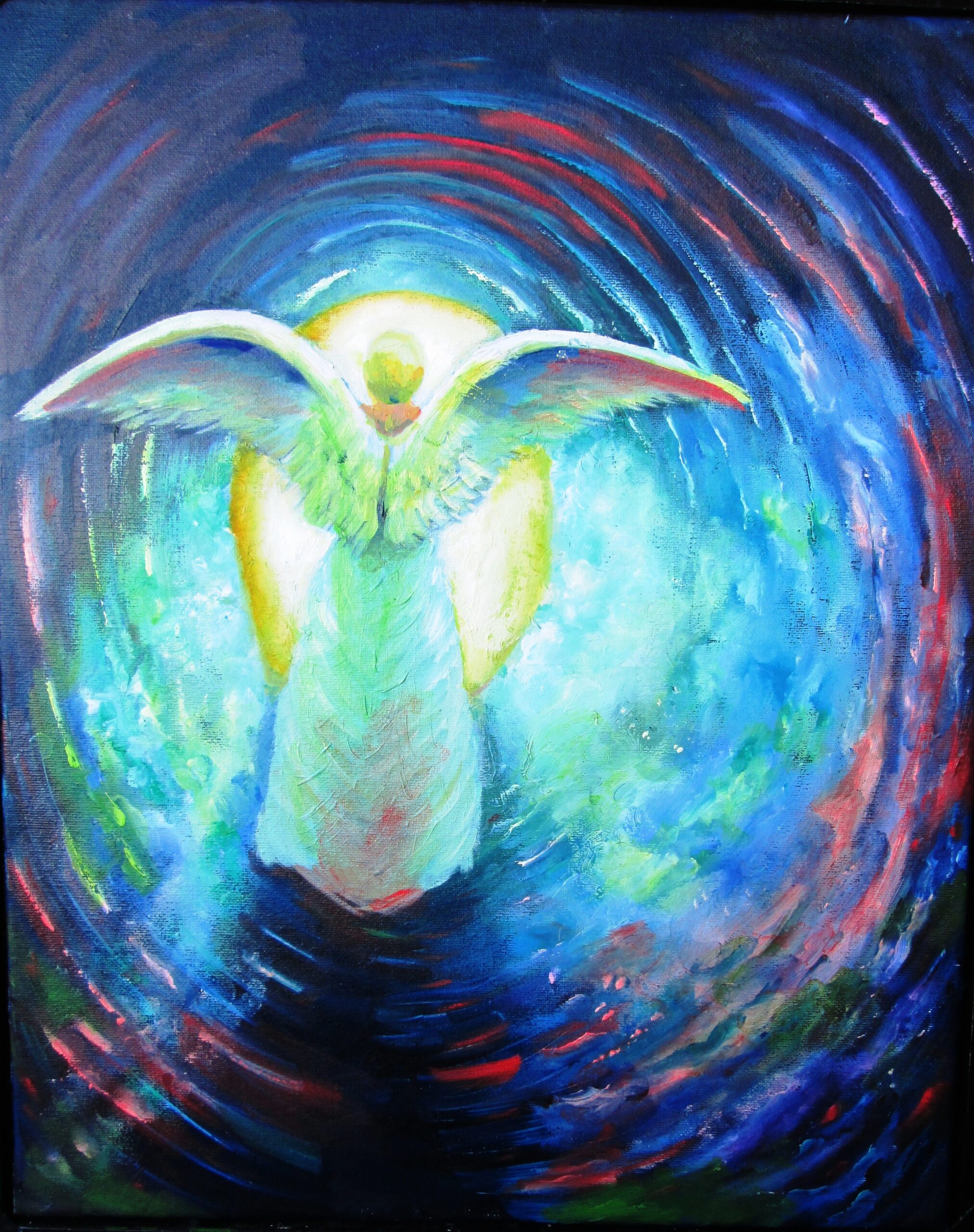
This painting portrays an angel standing within a circle of radiant light, symbolizing the transition from the physical world to the spiritual realm. The surrounding light represents Divine Presence, while the flowing path suggests the soul’s ascent toward higher levels of spiritual awareness.
Jewish mystical tradition teaches that angels accompany and protect the soul during its spiritual journey. They are viewed as messengers of God who guide, protect, and fulfill the Divine will. The painting therefore expresses hope, peace, and the continuing relationship between the Creator and the eternal soul.
Many people who have experienced near-death experiences describe seeing a brilliant light or passing through a tunnel of light. Although such descriptions appear in modern accounts, Jewish tradition focuses primarily on the soul’s return to God and does not define these experiences as a universal stage for every person.
Rather than depicting death itself, this artwork reflects the Kabbalistic understanding that the soul’s journey continues beyond the limits of physical life and ultimately seeks reunion with its Divine origin.
✦ The Hebrew Alphabet – The DNA of Creation
How do the Hebrew letters connect the spiritual and physical worlds?
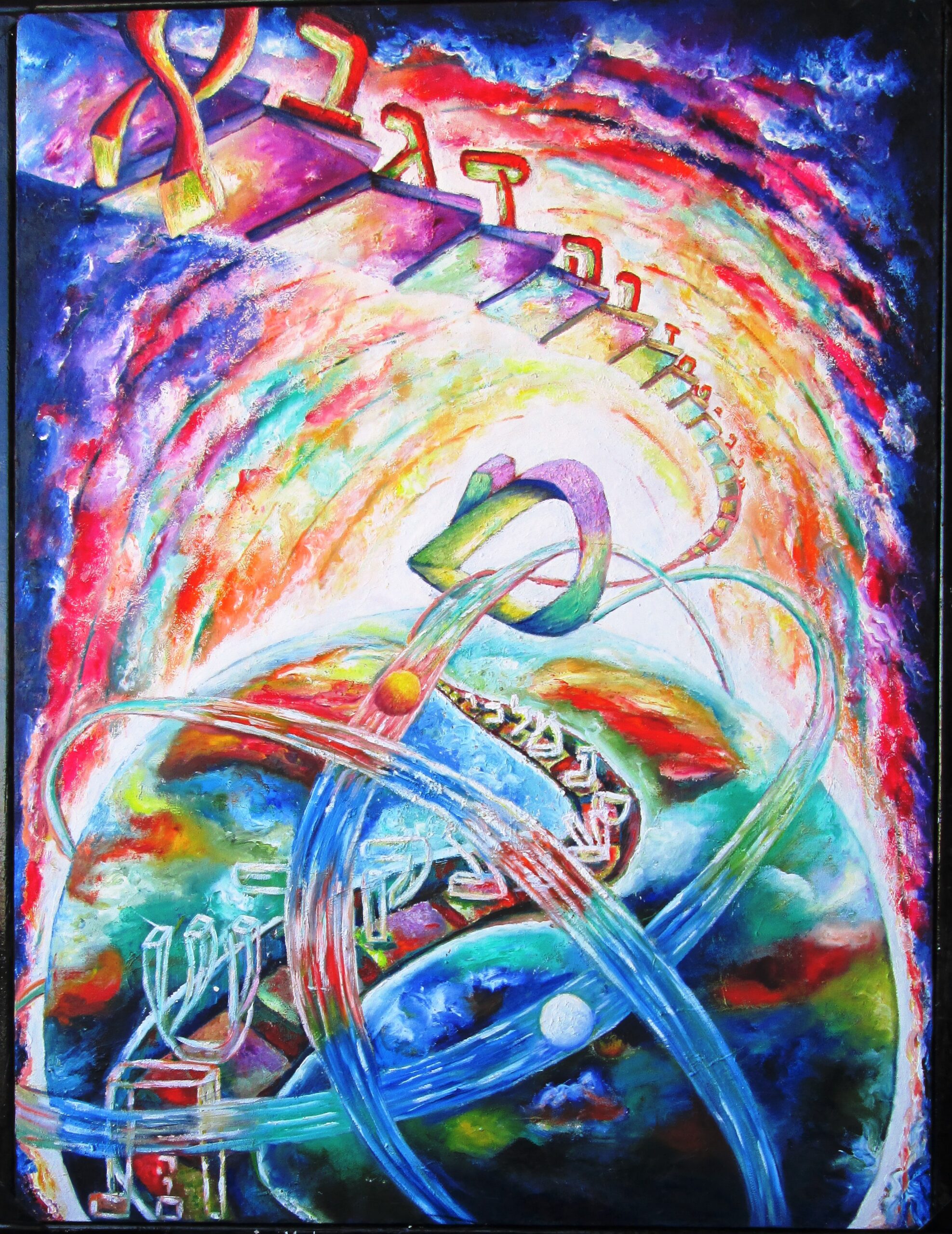
According to the Kabbalah and the Sefer Yetzirah (Book of Formation), the twenty-two Hebrew letters are far more than symbols of language. They are regarded as the spiritual building blocks through which God brought creation into existence.
The Sefer Yetzirah teaches that God created the universe through the 32 Paths of Wisdom-the ten Sefirot and the twenty-two Hebrew letters.
This painting presents the Hebrew alphabet as the spiritual “DNA” of creation. Just as DNA contains the code that shapes every living organism, the Hebrew letters symbolize the Divine blueprint that underlies every level of existence. Every creature, every force of nature, and every aspect of reality reflects this spiritual pattern.
The flowing forms connecting Heaven and Earth represent the continuous interaction between the spiritual and physical worlds. According to Kabbalah, the higher worlds influence the material world through Divine energy, while human actions, prayer, and spiritual growth create a reciprocal connection that elevates the physical world toward its spiritual source.
The Hebrew letters ascending toward the light symbolize the eternal bond between Divine wisdom and creation, reminding us that the visible universe is sustained by an unseen spiritual foundation.
✦ The Crossroads of Choice
According to Jewish tradition and Kabbalistic teachings, a person is never spiritually alone. Four principal angels are associated with Divine protection and guidance:
✦Michael stands on the right, representing kindness, compassion, and advocacy.
✦Gabriel stands on the left, symbolizing strength, discipline, and justice.
✦Uriel walks before the person, illuminating the path with wisdom.
✦Raphael stands behind, bringing healing, protection, and restoration.
✦Above all rests the Shechinah-the Divine Presence that surrounds and accompanies the soul.
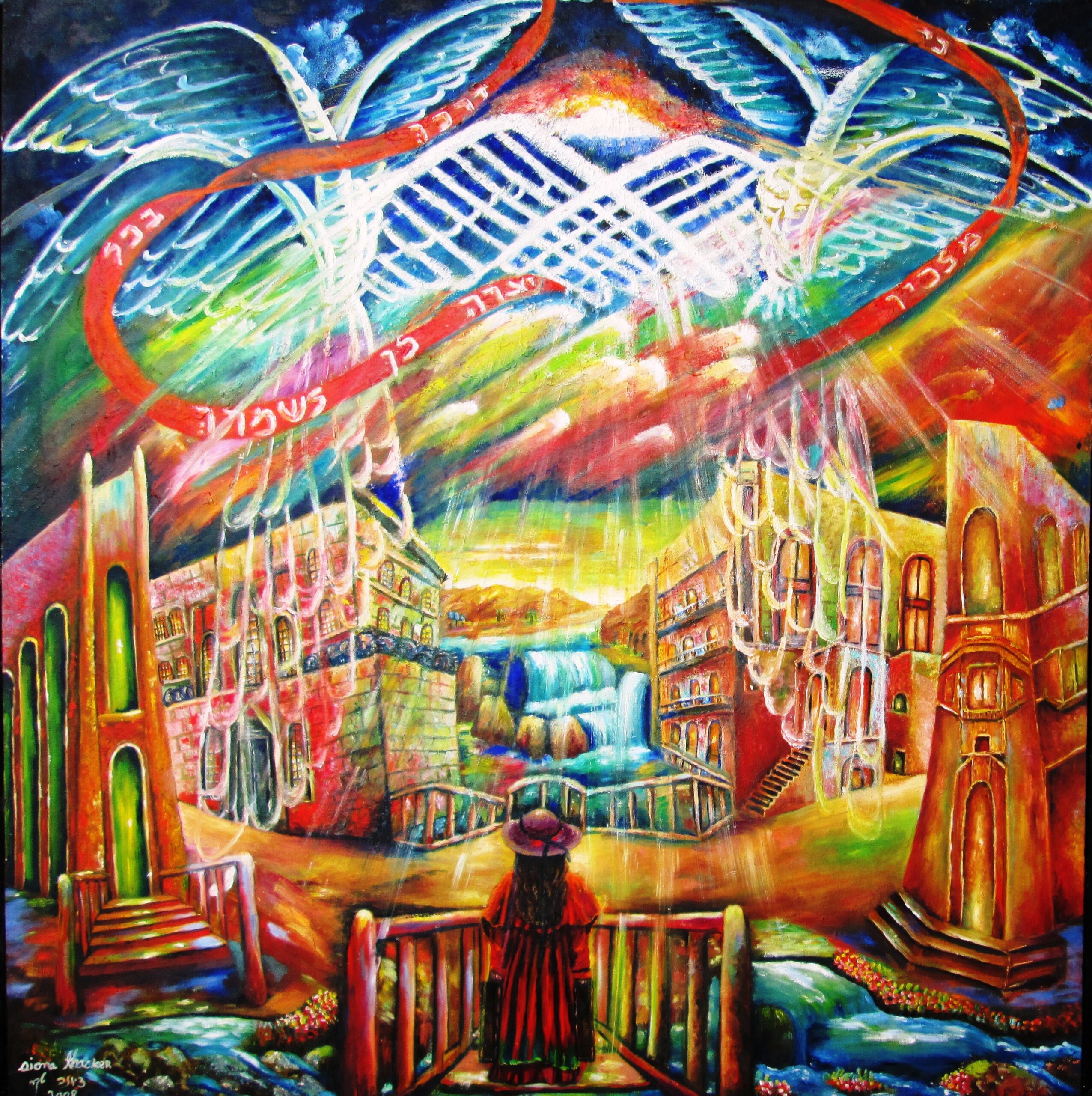
This painting portrays a person standing at a crossroads between different paths in life. The angels do not force a decision. Instead, they accompany the individual while preserving the greatest gift given to humanity: free will.
In Kabbalah, every decision creates spiritual consequences. Choosing kindness, truth, and compassion strengthens the path toward light, while negative choices distance a person from that harmony. The painting reminds us that although Heaven offers guidance, the direction we ultimately follow is determined by our own choices.
✦ When the Soul Ascends
Where does the soul go while we sleep?
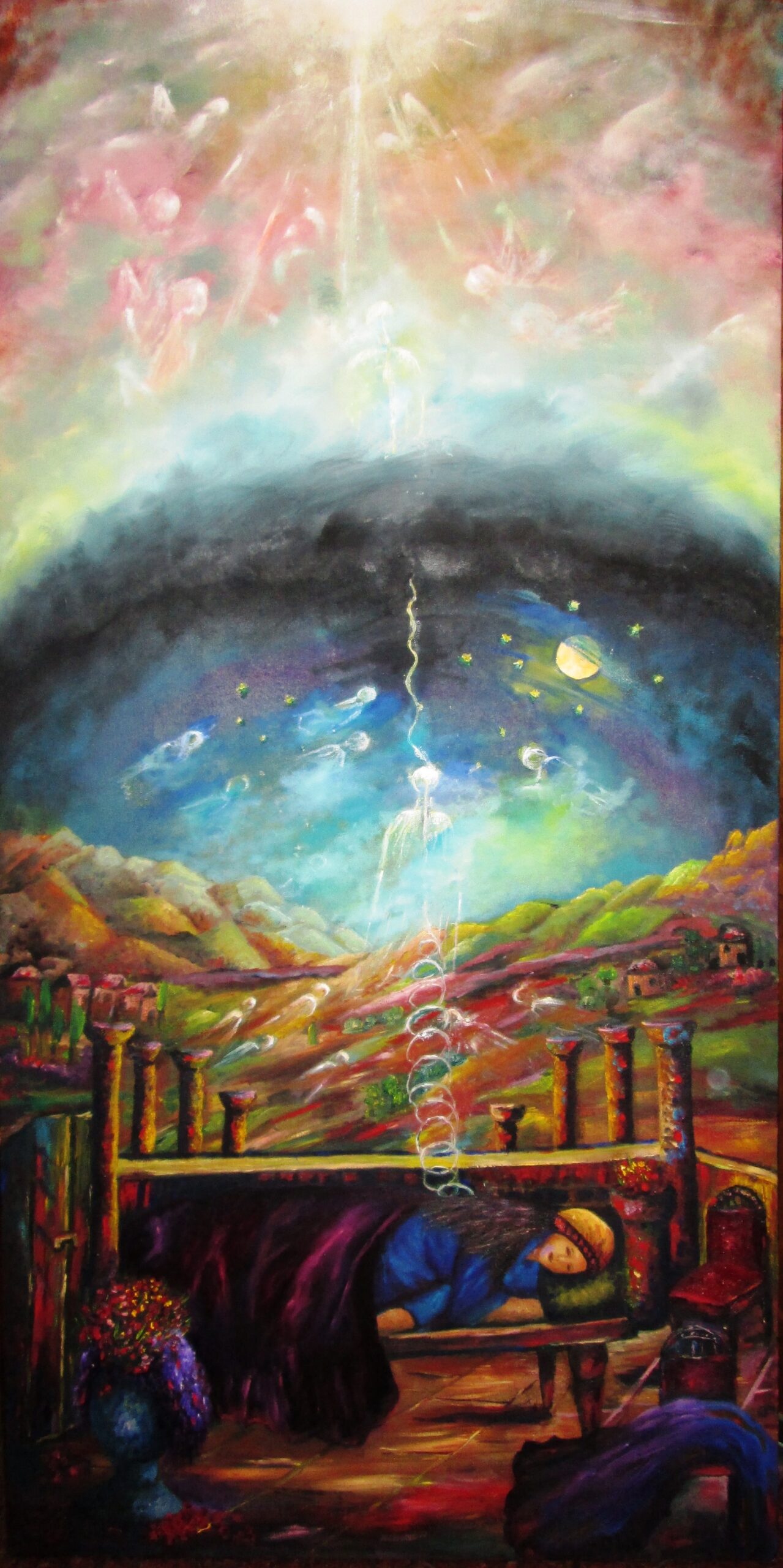
According to Kabbalah, every human being exists simultaneously in two dimensions: the physical world and the spiritual world. During the day, the body is active in the material world, while at night, as the body sleeps, the soul ascends to higher spiritual realms.
Jewish mystical tradition teaches that sleep is more than physical rest. It is a time of spiritual renewal, during which the soul reconnects with its higher source, receives renewed vitality, wisdom, and Divine influence, and may experience visions or messages that later appear as dreams.
According to Kabbalistic tradition, the soul remains connected to the body through a spiritual bond often referred to as the Silver Cord. This invisible connection allows the soul to find its way back to its physical body after its nightly journey through the spiritual worlds.
If this spiritual bond is permanently severed, the soul can no longer return to the body. Physical life comes to an end, and the soul continues
its eternal journey in the higher spiritual realms.
For this reason, sleep is considered nourishment for both body and soul. The body regains physical strength, while the soul is renewed through its connection with its Divine source. Without proper sleep, a person becomes physically exhausted and mentally confused because both the body and the soul require restoration.
This painting portrays the soul ascending toward the Divine Light, surrounded by angels and the heavenly realms, while remaining connected to the sleeping body through the Silver Cord. It symbolizes the eternal relationship between Heaven and Earth, body and soul, and the continuous flow of spiritual life.
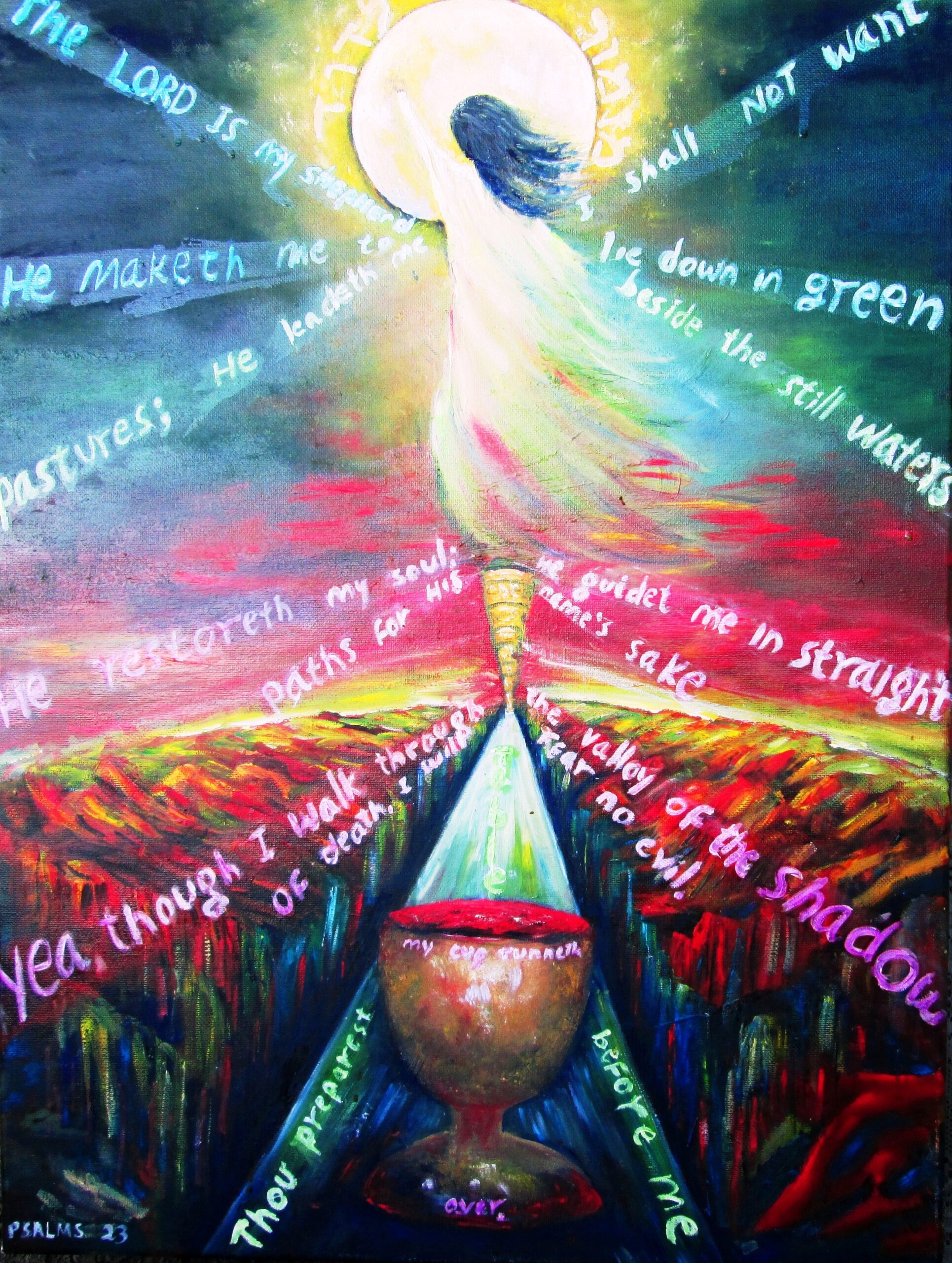
✦ I Lift My Eyes to the Mountains
Where does our help truly come from?
This painting is inspired by Psalm 121, one of the Songs of Ascents, traditionally sung by pilgrims as they journeyed to Jerusalem. It opens with the well-known words:
“I lift up my eyes to the mountains—where does my help come from? My help comes from the Lord, the Maker of heaven and earth.” (Psalm 121:1–2)
The painting symbolizes the soul’s spiritual journey. On the left, the arches represent the path through the physical world, while the luminous passage on the right symbolizes the transition toward the heavenly spiritual realm.
Above, the heavens are filled with Divine light, reminding us that God’s presence watches over every step of our journey. The verses from Psalm 121 flowing across the sky emphasize God’s continual protection and guidance.
The psalm teaches that true security does not come from human strength alone, but from the Creator of heaven and earth. Whether walking through the challenges of daily life or seeking spiritual elevation, God accompanies every soul.
The painting invites the viewer to lift their eyes beyond the visible world and remember that every journey-physical and spiritual-is guided by Divine providence.
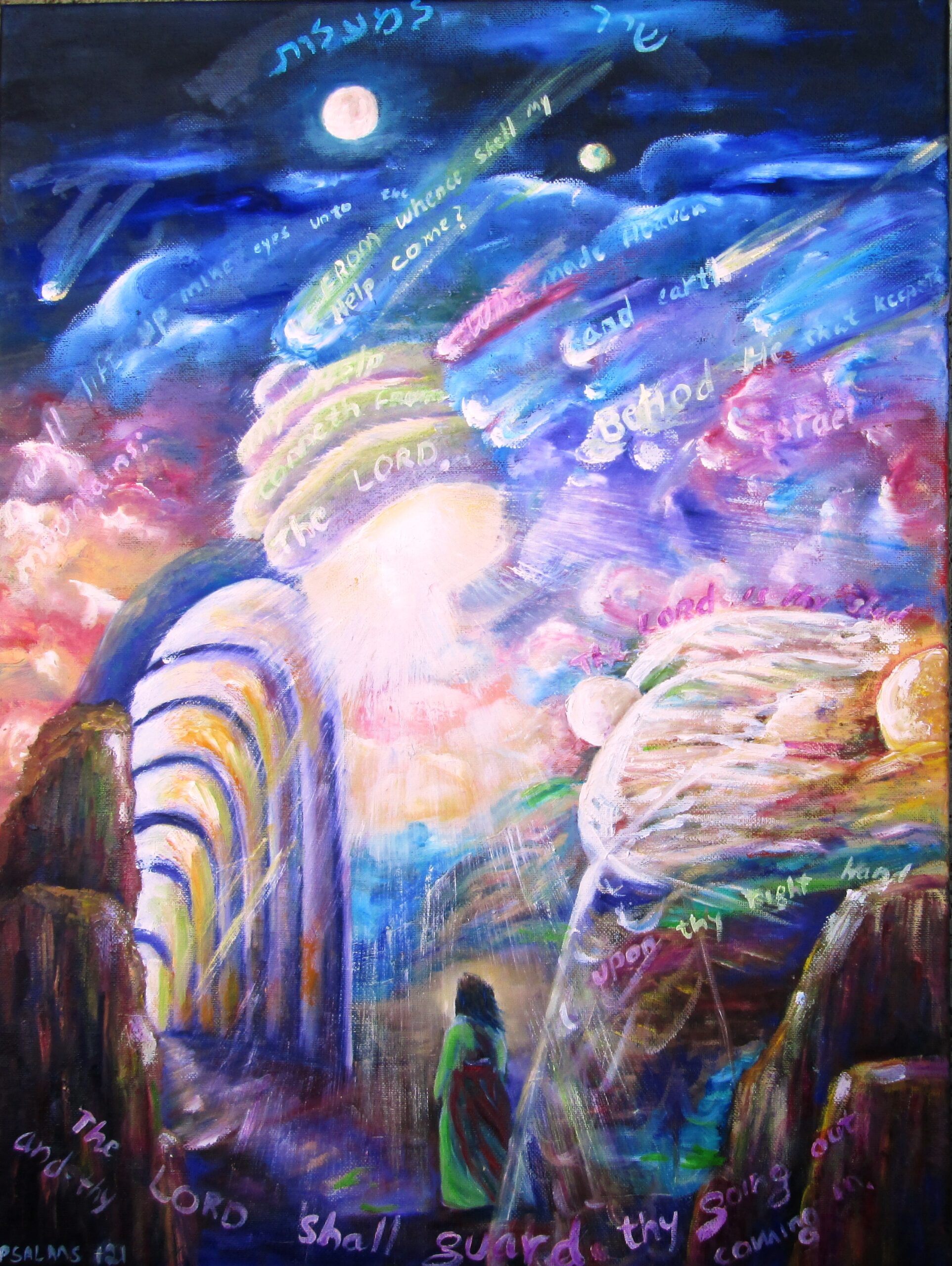
✦ The Lord Is My Shepherd
Who guides us through life’s darkest valleys?
This painting is inspired by Psalm 23, one of the most beloved psalms written by King David. It expresses complete trust in God, who guides, protects, and sustains the soul throughout life’s journey.
The narrow path symbolizes the unknown road that every person must walk. None of us knows what tomorrow will bring, yet faith gives us the strength to continue. Even when the path passes through darkness, uncertainty, or suffering, the soul is never alone.
The figure ascending toward the Divine Light represents the human soul placing its trust in God. The words of the psalm remind us that true peace comes from knowing that God’s presence accompanies us through every stage of life.
The cup at the end of the path symbolizes the final verse of the psalm:
“My cup overflows.”
In biblical tradition, the overflowing cup represents Divine blessing, abundance, protection, and spiritual fulfillment. It reminds us that those who place their trust in God are sustained not only with physical needs but also with inner peace, hope, and spiritual richness.
This painting is a visual meditation on faith, courage, and the enduring promise that God’s presence remains with us-even in the valley of the shadow of death.
✦ The Tree of Life
What does the Torah teach us about the purpose of life?
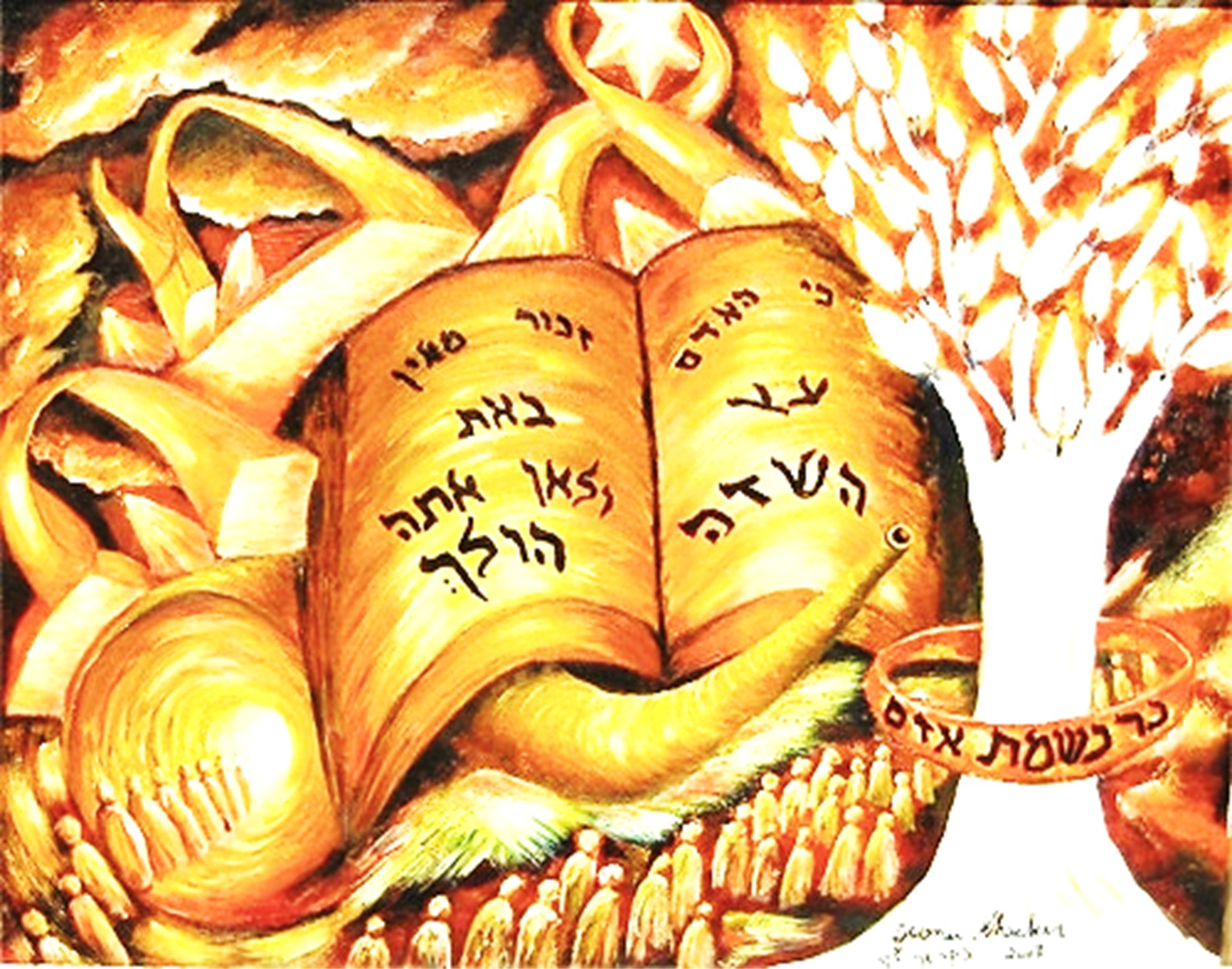
This painting is inspired by timeless teachings from the Torah and Pirkei Avot, reminding us that life is a journey guided by wisdom, responsibility, and spiritual growth.
At the center stands the open Torah, bearing the well-known teaching:
“Know from where you came, where you are going, and before Whom you will one day give an account.” (Pirkei Avot 3:1)
These words, spoken by Akavya ben Mahalalel, encourage humility, self-reflection, and awareness that every action has meaning and consequence.
To the right appears the Tree of Life, symbolizing spiritual growth and the verse:“For man is like the tree of the field.” (Deuteronomy 20:19)
Although the biblical verse appears in the context of protecting fruit trees during wartime, Jewish tradition has long understood the tree as a symbol of human life. Just as a tree grows through strong roots, care, and nourishment, so too does a person grow through faith, wisdom, and righteous deeds.
The shofar represents spiritual awakening and the call to return to God, while the menorah symbolizes Divine light and the eternal presence of holiness. The gathering of people below reflects the unity of Israel receiving the guidance of the Torah from generation to generation.
Together, these symbols express the enduring message that the Torah is a source of life, guiding every person toward purpose, moral responsibility, and spiritual elevation.