From the series: Life Before and After Death
To understand what happens to a person after death, we must begin with a question that may seem much simpler:
What is a human being?
Is a person the body we see? Is a person the brain, the heart, the eyes, and the hands? And if the body is the whole person, what exactly happens at the moment when the body is still before us, all its organs still in place – yet the person can no longer see, hear, speak, or respond?
This is not only a question about death. It is a question about life itself. Before we can ask what remains of a person after the body ceases to function, we must first understand who the person was while the body was alive.
Three Partners in the Creation of a Human Being
The Sages describe the creation of a human being in an extraordinary way. The Talmud teaches that there are three partners in a person: the father, the mother, and the Holy One, blessed be He. The father and mother provide the components involved in forming the physical body, while the Holy One, blessed be He, gives the person spirit and soul, the sight of the eyes, the hearing of the ears, the speech of the mouth, the ability of the legs to walk, understanding, and intellect. And when the time comes for a person to depart from this world, the Talmud says that the Holy One, blessed be He, takes His part, while the parents’ part remains before them. (Source – Niddah 31a)
Consider for a moment the image these words create. A person who only a short time ago looked at the people around him, heard their voices, spoke, thought, remembered, felt, and moved his body now lies before them. The eyes are still there, but they do not see. The ears are there, but they do not hear. The mouth is there, but it does not speak. The legs are there, but they do not walk. The brain, the heart, and the other organs of the body are still there as well.
What, then, has changed? If the eye itself is what sees, why does it no longer see? If the ear itself is what hears, why does it no longer hear? If the mouth is what speaks and the leg is what walks, why can they no longer perform the actions they carried out throughout the person’s life?
It is precisely at this point that the distinction between the human being and the body in which the person lives becomes clear.
The Body Is a Vessel – Not the Whole Person
Sha’arei Kedusha contains a striking statement: “The human body is not the human being itself by virtue of the body.” The body is described as a garment in which the inner spiritual reality of the person is clothed during life in this world.
The body is not unnecessary, nor is it unimportant. On the contrary, it is a remarkable and complex vessel through which the soul can act in the material world. Through the body we can see, hear, speak, walk, touch, create, build, learn, embrace, help another person, and transform thought and intention into physical action.
But the body and the soul are not of the same essence. The body is physical, while the soul is spiritual. Yet there is a correspondence between their structures, allowing the soul to clothe itself in the body and act through its organs.
Think of a garment tailored precisely to the measurements of the person who will wear it. Its sleeves correspond to the arms, its lower part corresponds to the legs, and the entire garment takes the shape of the person wearing it. When the person raises an arm, the sleeve rises with it; when the person walks, the garment moves along with the body. But the garment does not raise itself, nor does it walk on its own. When the person removes it and places it on a chair, its shape remains, but it no longer moves.
This is one way to understand the concept of the body as a garment. The body is suited to the soul, and the soul acts through it during life. They are deeply connected, but they are not of the same essence – one is physical and the other spiritual.
The Body Is Formed According to the Spiritual Structure
The idea becomes even more profound when we consider the structure of the human being. Just as a craftsman creates a garment according to the form of the person who will wear it, the body is described as being formed “in the pattern of the image of the soul.” The physical body is described as having 248 organs and 365 sinews, corresponding to 248 spiritual organs and 365 spiritual sinews in the spiritual structure. (Source – Sha’arei Kedusha, Part I, Gate I)
This does not mean that a spiritual organ and a physical organ are of the same essence. One belongs to spiritual reality and the other to physical reality. But their structures correspond. The spiritual structure corresponds to the structure of the body and its organs so that the soul can clothe itself in the body, give it life, and act through its organs.
The spiritual organs act through the organs of the body, and the writings compare this to “an axe in the hand of the one who hews with it.” The axe performs the action, but it is not the source of intention or movement. It is the instrument through which the person holding it acts. In the same way, the organs of the body are the physical instruments through which the soul acts in the material world.
This correspondence can also be illustrated by a complex electrical system. A machine may consist of dozens or hundreds of components, but it is not enough for electricity to reach only one point in the system. For the entire system to function, the current must reach its various parts. If, for some reason, the current does not reach a particular component, that component will not function, even if it is physically intact and undamaged.
Of course, the soul is not electricity and the body is not a machine. This is only an analogy. But it helps explain why the spiritual structure is described as corresponding to the entire physical body. The soul is not described as a single point located somewhere inside the body and operating it from the outside. It clothes itself in the physical structure that corresponds to it, and through this connection it can act through the organs of the body.
The Body Belongs to the Material World
Our body is physical, and therefore it is subject to the same principle we observe throughout the material world: forms change, materials break down, and their components return to nature.
Iron, for example, does not remain forever in the same form. An object made of iron can rust and gradually disintegrate over the years. The iron does not simply “disappear” from existence. Its form changes, and the material from which the object was made enters other processes in nature. The same is true of wood that decays, a leaf that falls, or the body of an animal after death. The form we once knew gradually ceases to exist, but the components of matter do not become nothing.
The human body also belongs to this world. It is built from matter, sustained by matter, and ultimately returns to the material world from which it was formed. The biblical words “for dust you are, and to dust you shall return” describe this process with remarkable simplicity. (Source – Genesis 3:19)
The Kabbalistic tradition also describes created existence through the four elements – fire, air, water, and earth. In the writings of the Ari, these four elements appear as part of the description of created beings, while Sefer Yetzirah presents an earlier structure involving “spirit from spirit,” “water from spirit,” and “fire from water,” and later also describes earth.
There is no need to explore here the full spiritual meaning of the four elements, since that is an extensive subject in its own right. What matters for our discussion is that the body belongs to the system of the material world and is therefore subject to change, decomposition, and a return to matter. (Source – Sha’ar HaGilgulim, the Four Elements)
(Source – Sefer Yetzirah)
The important point for our discussion is simple: the body does not vanish after death. It changes its state and gradually returns to nature. “For dust you are, and to dust you shall return” refers to the body, whose origin is in the material world and which returns to it. This does not contradict the continued existence of the soul, because the soul is not composed of the material substance to which the body returns.
But this raises another question: If the body remains, at least initially, and all of its organs are still present – what is missing from it after death?
If the Body Is Intact – What Is Missing After Death?
Death itself allows us to see the distinction between the body and the life that was expressed through it with particular clarity.
When a person dies, the body is still before us. Especially immediately after death, all the organs may still be in place. There are eyes, ears, hands, and legs. There are the brain, the heart, and the other systems of the body. And yet something fundamental has changed.
The eyes are there, but the person no longer sees through them. The ears are there, but the person no longer hears through them. The mouth and tongue remain, but the person does not speak. The hand is there, but it does not reach out to take anything. The leg is there, but it does not rise to walk.
The mere physical presence of an organ, therefore, is not enough to explain the activity of a living human being.
Think of a musical instrument. A piano can be completely intact, every key and string in its proper place, and yet it will not play by itself. The instrument allows music to be heard in the world, but the existence of the instrument alone is neither the music nor the musician. This is only an analogy, of course, but it helps illustrate the difference between the physical instrument and the soul acting through it.
The body is the physical vessel through which human life is expressed in this world. The soul is not simply another physical organ somewhere inside the body. It is not matter that can be found during an operation or placed on a table. It is spiritual, and its activity is expressed through the body for as long as the connection between them exists.
The Five Senses – The Instruments Through Which We Encounter the World
Our five senses also function through physical instruments. We see through the eyes, hear through the ears, smell through the nose, taste through the mouth, and experience touch through the body.
Yet again, the organ itself does not explain the whole experience. The eye is a physical organ that enables a person to receive light and visual information, but seeing is part of the experience of a living person. The ear is a physical organ, but it is the person who experiences sound. After death, the physical instruments may remain, but the person no longer uses them to experience the surrounding world.
The distinction becomes even more interesting when we move from the senses to things we cannot touch at all. A person does not merely see and hear. A person also thinks, remembers, desires, loves, fears, becomes angry, feels joy, hopes, and chooses. Thoughts and emotions have expressions in the body, and we can identify bodily processes that accompany them, but we cannot hold a thought in our hand, weigh love, or place a memory on a table.
The human being we know is therefore much more than a collection of organs.
The brain, too, is an extremely important physical organ. It is part of the system through which a person acts in this world, but that does not mean that the brain is the soul. In the writings of the Ari we find the expression: “The brain is a vessel for the Neshamah, the heart for the Ruach, and the liver for the Nefesh.”
The distinctions between Nefesh, Ruach, and Neshamah, and their relationship to the brain, heart, and liver, will be left for a separate article, because this is an entire subject in itself. For now, it is enough to understand one principle: the spiritual dimension of the human being acts in the physical world through a bodily system suited to it.
What Are We Really Able to See?
One reason it may be difficult for us to think about the human being in these terms is that we are accustomed to identifying reality with what our senses can perceive. If we cannot see something, touch it, or measure it as a physical object, it is easy to assume that it does not exist.
Yet even in everyday life we know that not everything that acts upon matter is itself visible to the eye.
We do not see the wind itself. When it passes through the trees, we see the leaves move, the branches bend, dust rise, and waves form on the surface of the water. We do not see the wind in the same way that we see a stone or a table, but we recognize its presence through its effect on matter.
The same is true of electricity. We do not see an electric current with our eyes in the same way that we see the device it reaches. We see the results of its activity: the light turns on, the motor begins to rotate, and the device begins to operate.
These examples are not proof of the existence of the soul, nor are they meant to suggest that the soul is a type of physical wind or electricity. They illustrate a simple principle: not everything that acts through matter must itself be a physical object that can be seen or touched.
The soul is a spiritual reality. We should therefore not expect to find it as another physical organ inside the body. We encounter the activity of the living person in this world through the body in which the soul is clothed and through which it acts.
The Vessel and What It Contains
We can also understand this distinction by thinking of a glass filled with water. The glass is the vessel, and the water is contained within it. As long as the water is in the glass, we see them together, but it is obvious that the glass and the water are not of the same essence. The glass is the vessel, and the water is what it holds. If we pour out the water, the glass remains. The vessel has not disappeared, but what it contained is no longer within it.
Again, this does not mean that the soul is literally water or that the body is literally a glass. The analogy simply helps us understand the distinction between the vessel and what is clothed within it and acts through it.
The body is the soul’s physical vessel in this world. It corresponds to the soul and enables it to act within material reality. During life, the connection between them is so complete that we experience ourselves as one human being. We do not say every time, “My soul has just activated my hand.” We simply say, “I raised my hand.” We do not say, “My soul has just used my eyes.” We say, “I saw.”
The connection between body and soul is such a natural part of our experience of life that it is only when that connection begins to end that the distinction between the vessel and the soul acting through it becomes clear.
A Limb That Is No Longer There – Yet Is Still Felt
There is an intriguing medical phenomenon that adds another thought-provoking dimension to this discussion. People who have lost an arm or a leg may sometimes continue to feel the missing limb. A person whose leg has been amputated may experience pain in a foot that is no longer physically present and may even feel as though the toes are contracting or the leg is positioned in a particular way.
This phenomenon is known medically as a phantom limb, and it is explained through processes involving the brain and nervous system. It should therefore not be regarded as scientific proof of the existence of a spiritual limb.
Yet in the context of our discussion, it raises an interesting thought. It shows that a person’s experience of the body is more complex than the physical boundaries visible to the eye. A physical limb may no longer be present, and yet a person may continue to experience sensations associated with it.
When this is considered alongside the description of a spiritual structure corresponding to the physical structure, an intriguing question arises. The spiritual organ and the physical organ are not of the same essence. One is spiritual and the other physical, even though their structures are described as corresponding to one another.
This is not proof, but rather a point for reflection. It brings us back to the idea with which we began: the body we see is not necessarily all that there is to the human being.
The Body Returns to Dust – The Soul Returns to Its Source
We now return to the moment of death. A person dies, and the body is still before us. The eyes, ears, hands, and legs remain, but they no longer function as they did before. What we observe externally is the cessation of the body’s activity. The spiritual explanation addresses what occurs beyond that outward appearance: the soul gradually separates from the physical vessel through which it acted in this world.
We can now understand why the words “for dust you are, and to dust you shall return” do not contradict the continued existence of the soul. The body does indeed come from dust and return to dust. That is the nature of matter. But a human being is not the body alone, and therefore what is said about the destiny of the body does not necessarily describe the destiny of the soul.
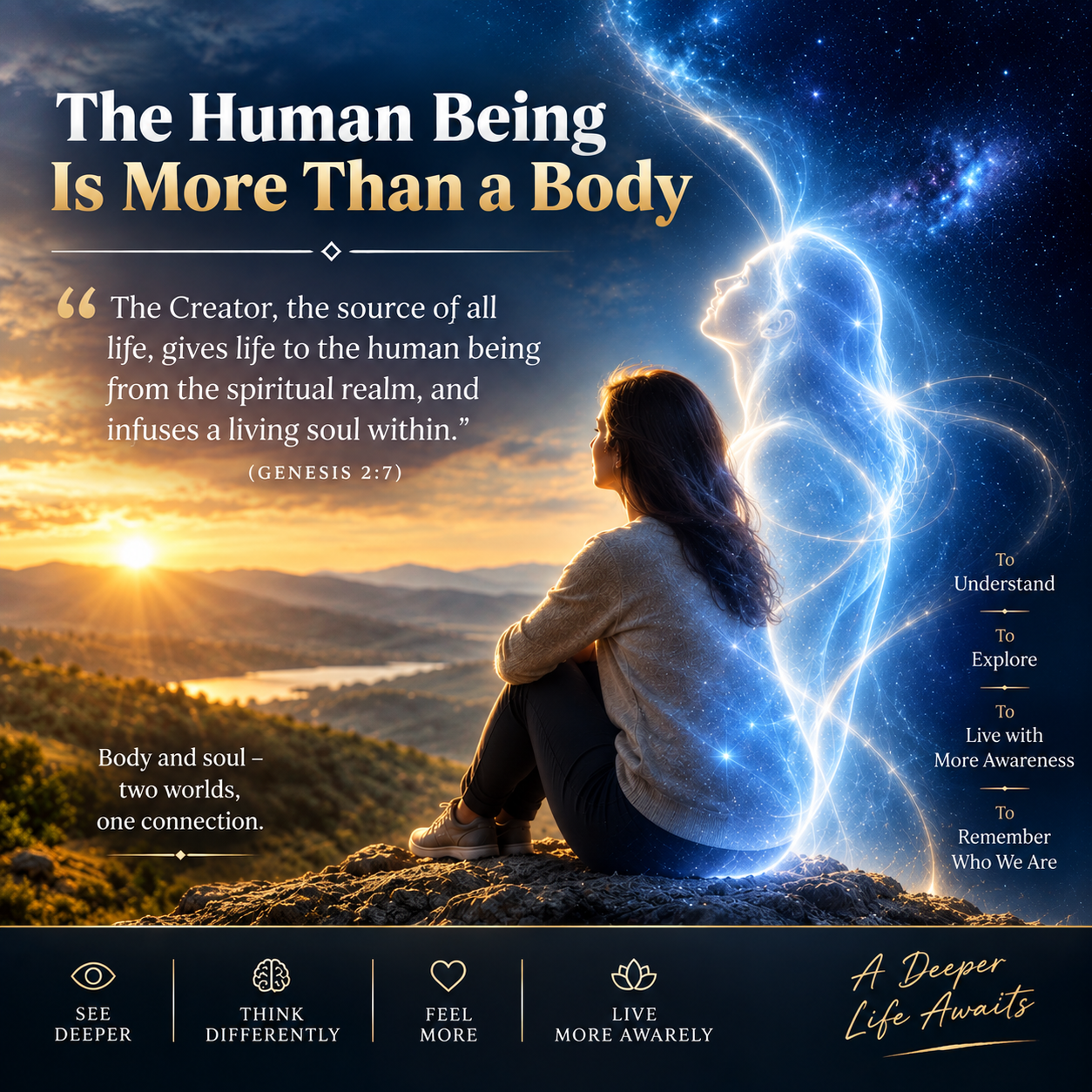
The biblical account of the creation of the human being already states: “And the Lord God formed man of the dust of the ground, and breathed into his nostrils the breath of life; and man became a living soul.” On one side is the dust of the earth; on the other is the breath of life. The two are joined, and only then is the human being described as a living being. (Source – Genesis 2:7)
Throughout life, body and soul are connected and act together. At death, the process of separation begins. The body returns to the material world from which it was formed, while the soul does not perish with it but returns to its source in the higher realms.
And here the teaching with which we began takes on an additional meaning. There are three partners in the creation of a human being: the father, the mother, and the Holy One, blessed be He. The body received through the parents remains in the material world and returns to it, while the spiritual part given to the person does not return to dust. When the time comes for a person to depart from this world, the Sages say that the Holy One, blessed be He, “takes His part.”
The Human Being Is a Connection
A living human being is the meeting point of two different realities. On one side is the physical body, which belongs to the material world and functions within it. On the other is the spiritual reality of the human being, described in different levels, including Nefesh, Ruach, and Neshamah.
During life, these two realities are connected. The soul gives life to the body and acts through it, while the body serves as its physical vessel, allowing it to express itself and act within the material world.
As long as this connection exists, the human being lives and functions in the physical world. When the separation between soul and body begins, the process we call death begins.
But this raises another important and intriguing question: Does the connection between body and soul end in a single moment, or does the process of separation begin even before death?
The Zohar describes a process that begins earlier and connects it with the person and his tzelem – his spiritual image – already thirty days before death.
What happens during those thirty days? What changes in the person and in his tzelem, and what occurs as the moment of separation between soul and body draws nearer?
That is the subject of the next article in this series:
What Happens Thirty Days Before Death?