✦ OPENING ARTICLE
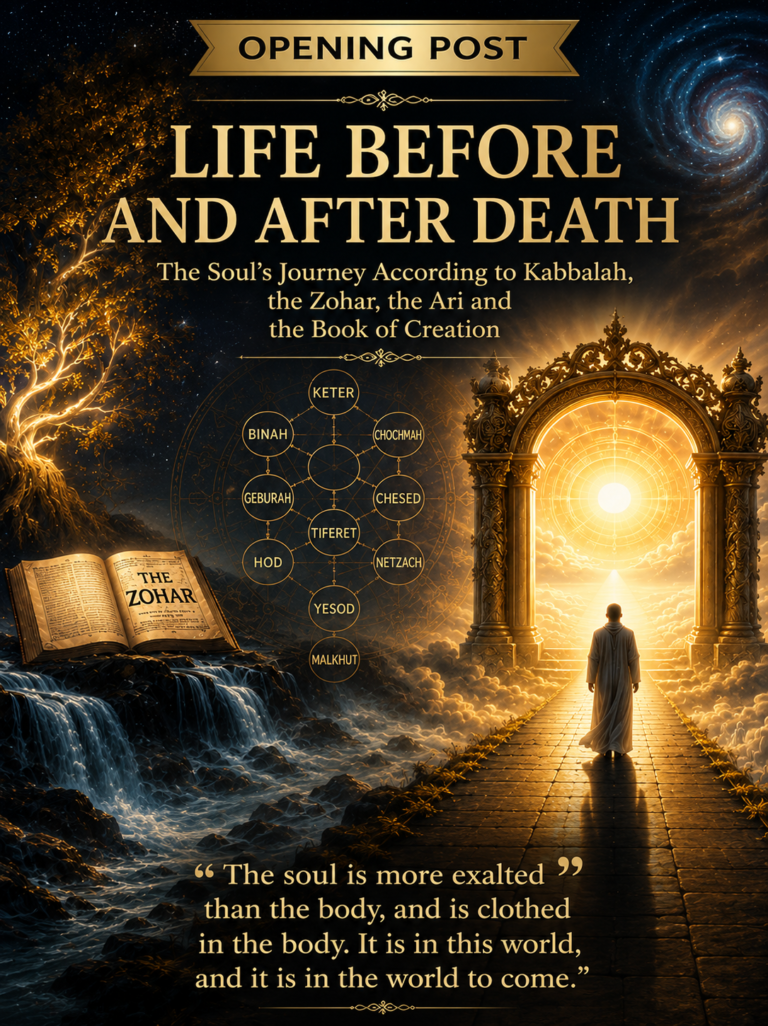
✦ Life Before and After Death
The Journey of the Soul According to Kabbalah, the Zohar, the Writings of Rabbi Isaac Luria (the Ari), and the Book of Creation (Sefer Yetzirah)
What happens to a person as life in this world draws to an end? Does the process of separation begin only at the moment when the body ceases to live, or does it begin earlier? And what happens to the soul when it is released from the body and continues its journey beyond the physical world?
The question of life and death has accompanied humanity throughout the ages. We know what happens to the body physically when its systems cease to function, but what takes place in a dimension we cannot see?
Is death the absolute end of existence, or is it a passage from one dimension to another?
According to Kabbalah, in order to understand what takes place before and after death, we must begin with a more fundamental question:
✦ What is a human being?
A Human Being Is More Than a Body
According to Kabbalah, even what we call “matter” does not exist by itself. Everything in creation contains a spiritual life-force that gives it vitality and sustains its existence – in the inanimate, the plant world, the animal world, and the human being. The earth, the waters, plants, and the entire reality surrounding us are not understood as matter completely disconnected from the spiritual realm. Yet within the human being there is an additional dimension, deeper and more complex – the soul.
Therefore, when we speak about the death of a human being, we are not speaking only about a body that ceases to function, but about a profound change in the relationship between the body and the spiritual forces that sustain its life.
Kabbalistic literature speaks of the four elements – fire, air, water, and earth. But the four elements are not the entire story. Matter itself does not exist without the spiritual force that gives it life and sustains it. From the inanimate to the plant world, from animals to human beings, every level of creation possesses a life-force appropriate to its nature.
In the human being, an additional, deeper and more complex spiritual dimension is present – the soul.
The account of the creation of Adam already tells us:
“And the Lord God formed man of the dust of the ground… and breathed into his nostrils the breath of life.”
Two dimensions meet within the human being: a body that belongs to the physical world and a soul whose source is in the spiritual realm. Throughout a person’s life, they function together, and the soul gives life to the human being through its connection with the body.
When the time comes for a person to leave this world, the body, which belongs to the physical realm, remains in the physical dimension and returns to the natural world to which it belongs. The soul does not die with it. It separates from the body and returns to its higher source.
But the statement “the soul separates from the body” is only the beginning of the story.
How does this separation actually take place? When does it begin? Does it happen in a single moment? And what happens to the Soul (Nefesh), Spirit (Ruach), and Higher Soul (Neshamah) during this process?
These are the questions we will explore throughout this series.
✦ Does the Process of Separation Begin Before Death?
One of the fascinating questions we will examine is what takes place before a person dies.
What happens to the soul thirty days before death?
Does a change in the relationship between the body and the soul already begin during this period?
✦ What is the Spiritual Image (Tzelem) described in the Zohar?
What does the concept of the “Spiritual Image” mean? Is it something that can be seen? Is there a connection between it and a person’s physical shadow, or does it refer to an entirely different spiritual reality?
What happens to the Spiritual Image as a person approaches death?
Why does the Zohar connect the Spiritual Image with approaching death?
Can a person sense that something within them is beginning to change?
Does the soul know that the time of its separation from the body is approaching?
And what exactly takes place during those thirty days before death?
✦ When Is a Person Truly Considered Dead?
Modern medicine determines death according to defined medical criteria. Alongside the irreversible cessation of heart and respiratory function, under defined medical conditions death may also be determined on the basis of irreversible brain and respiratory failure.
But when we turn to Kabbalah, another question arises:
Is the moment at which medicine determines that the body has died necessarily the same moment at which the connection between the body and the soul comes to an end?
According to the Zohar and Kabbalah, when does a person’s life actually end?
Does the cessation of brain function determine the moment of death?
Is it the cessation of breathing?
Is it the cessation of the heartbeat?
What happens to the soul when the systems of the body cease to function?
Does the departure of the soul take place at precisely the same moment at which the body is declared dead?
Can the soul leave the body and return to it?
And if so – what distinguishes a temporary departure of the soul from its final departure?
At what point does the separation between body and soul become irreversible?
And does the very departure of the soul from the body mean that the connection between them has already been completely severed?
Throughout this series, we will examine these questions in depth and return to the sources in order to understand whether physical death, the departure of the soul, and the separation of the soul from the body describe a single moment – or different stages of a process.
✦ What Happens on the Day of Death?
What happens when the day of death itself arrives?
What takes place during the final hours of a person’s life?
What happens at the moment when the connection between the soul and the body begins to come to an end?
How does the soul experience its separation from the body and from the physical world?
Does the departure of the soul happen in a single moment, or is it a process?
What does the expression “the departure of the soul” actually mean?
What does the soul see as it leaves the body?
Does it encounter other souls?
Is there anyone who comes to receive it?
And what is the Angel of Death (Malach HaMavet) described in the sources?
How do the Zohar and the Kabbalists describe it, and what is the meaning of those descriptions?
✦ What Is the Silver Cord?
The biblical Book of Ecclesiastes contains the mysterious words:
“Before the silver cord is severed…”
What is this Silver Cord (Chevel HaKesef)?
What is its connection to the body and the soul?
Does the soul separate completely from the body at the moment of death, or does a connection between them remain even after the soul has departed?
If a connection remains – what does that mean?
What happens to the Silver Cord after death?
When does the final separation between the soul and the body occur?
And what is the connection between the severing of the Silver Cord and the burial of the body?
Is it possible that the body is no longer alive and the soul has already departed, yet the connection between them has still not been completely severed?
And what does the soul experience during this period?
✦ What Happens During the First Days After Death?
What happens to the soul immediately after it leaves the body?
Where does it go?
Does it immediately leave the place where the person died?
Does it remain near the body?
What takes place between death and burial?
Is the soul aware of what is happening around the body?
Can it see the people who are there?
Can it hear what they are saying?
And what happens when the body is brought to burial?
What does the soul experience during the burial?
Why is burial significant not only for the body that remains in this world, but also for the journey of the soul?
And what changes after the burial has been completed?
✦ What Happens to the Soul, Spirit, and Higher Soul After Death?
Here the picture becomes even more complex.
Kabbalah does not limit itself to the general word “soul.” It distinguishes between different levels of a person’s spiritual existence, including the Soul (Nefesh), Spirit (Ruach), and Higher Soul (Neshamah).
But what happens to each of them when a person dies?
Do the Soul, Spirit, and Higher Soul separate from the body at the same time?
Do they all undergo the same process?
Do they remain together after death?
Do they all ascend to the same place?
Does one of these levels remain connected to the body or to the grave?
Does another ascend to the spiritual worlds?
And what happens to the connection that existed among them during the person’s lifetime?
In order to understand what takes place after death, we must therefore first understand what the Soul, Spirit, and Higher Soul are, what role each plays during a person’s life, and what happens to each after death.
✦ What Happens During the First Seven Days?
Why does Judaism observe a Seven-Day Mourning Period (Shiva)?
Are these seven days intended only for the grieving family, or does a process connected with the soul of the deceased also take place during this period?
Where is the soul during the Seven-Day Mourning Period?
Does it remain connected to the home in which the person lived?
Does it visit places associated with the person’s life?
Is it aware of the family members who are mourning?
Can it see or sense them?
And what changes when the seven-day period comes to an end?
✦ What Happens After Thirty Days?
The thirty days following death also have significance.
What takes place during the first thirty days after death?
Does the soul remain in the same state throughout this entire period?
Does it pass through different stages?
What changes on the thirtieth day?
And what is the relationship between the processes experienced by the soul and the mourning practices observed by those who remain in this world?
Here it will be important to distinguish between two entirely different periods that we will examine in this series: the thirty days before death and the thirty days after death.
What takes place during each of these periods, and why does the number thirty appear in both?
✦ And What Happens During the First Year?
Why is the first year after death considered a particularly significant period?
What stages does the soul undergo during that year?
Does the state of the soul change during the months following death?
Why is the Mourner’s Prayer (Kaddish) recited?
What is the significance of prayer, Torah study, charity, and good deeds performed for the Elevation of the Soul (Ilui Neshamah) of a person?
Can actions that we perform in this world affect a soul that is no longer within a physical body?
And what changes at the end of the first year?
✦ What Is the Judgment of the Soul?
If the body remains in this world while the soul continues on its journey, what happens when the soul must confront the life it has lived?
What is the Judgment of the Soul (Din HaNeshamah)?
Who judges the soul?
What is examined in this judgment?
Does the soul see its life again?
Does it experience the consequences of its actions?
Does it see things whose significance it did not understand while living?
How are actions performed in a physical world evaluated when the soul is no longer within a physical body?
What do reward and punishment mean in a spiritual reality?
And is the judgment the same for every soul?
✦ What Is the Spiritual Sling?
One of the most intriguing and least understood concepts associated with the soul’s journey after death is a spiritual state described in the Kabbalistic sources as the Spiritual Sling (Kaf HaKela).
What exactly is the Spiritual Sling?
Is it a place to which the soul goes, or a spiritual state that it experiences?
✦ Which souls undergo the Spiritual Sling, and why?
Not every soul undergoes the Spiritual Sling.
So what determines which soul will experience this process?
What does the soul experience in the Spiritual Sling?
Is there a connection between the way a person lived and this spiritual state?
Is there a connection between the manner in which a person’s life ended and what the soul experiences afterward?
And what do the sources say about the souls of people who ended their own lives?
What happens to the soul in the case of suicide?
How do the Kabbalistic sources understand a soul whose life in the body ended in this way?
And what is the difference between the Spiritual Sling and the Realm of Spiritual Purification?
✦ What Is the Realm of Spiritual Purification?
The Realm of Spiritual Purification (Gehinnom) is often translated into English as “Hell.” For many readers, however, the word “Hell” immediately evokes images of fire and eternal punishment.
But is that what the Zohar and Kabbalah actually mean?
✦ What is the Realm of Spiritual Purification according to the Kabbalistic sources?
Is it a place?
Is it a spiritual state?
What is its purpose?
Is it solely a punishment, or does it also involve a process of purification and spiritual correction?
What does the soul experience there?
Does every soul pass through the Realm of Spiritual Purification?
How long does the soul remain there?
Can the soul ascend from it?
Are there different levels or divisions within it?
And what determines what each soul will experience?
✦ What Is Paradise?
What happens when the soul reaches Paradise (Gan Eden)?
What exactly is Paradise in spiritual reality?
Is the Paradise described in Kabbalah the same Garden of Eden that appears in the biblical account of Creation?
What is meant by Lower Paradise (Gan Eden Tachton) and Upper Paradise (Gan Eden Elyon)?
Why is there a distinction between them?
Are all souls on the same spiritual level?
What determines the soul’s place?
What does the soul experience there?
Does the soul continue to learn and develop after reaching Paradise?
Can it pass from one spiritual level to another?
And does its journey end there?
✦ Does the Connection Between the Dead and the Living Truly End?
Perhaps this is one of the most personal and fascinating questions faced by anyone who has lost someone they loved.
When the body is no longer here – does the connection also end?
Does the soul of a person who has died remain connected in some way to family members?
Does it know what is happening to the people it left behind in this world?
Does it come to significant events in their lives?
Can the souls of parents, grandparents, and other family members be present at the celebrations and joyful occasions of their descendants?
Can the soul draw near to the physical world?
Can a living person sense its presence?
And what about dreams in which people who have died appear?
Is every dream about someone who has died an encounter with a soul?
Or is there a difference between an ordinary dream and a dream in which the soul actually appears?
Can a soul convey a message through a dream?
And how can we distinguish between these different experiences?
What do the sources say about attempts by the living to communicate with the dead?
✦ Can We Affect the Soul of Someone Who Has Died?
If the soul continues its journey after the death of the body, can the actions of the living affect it?
What is meant by the Elevation of the Soul (Ilui Neshamah)?
Why is the Mourner’s Prayer (Kaddish) recited?
What does prayer do for the soul of the deceased?
What is the significance of giving charity in a person’s memory?
What happens when Torah is studied or a good deed is performed for the Elevation of the Soul?
Can a good deed that we perform here contribute to the elevation of a soul that is already in the spiritual world?
And if so – how can an action performed in the physical world affect a soul existing in another dimension?
✦ And Where Does the Soul Go From Here?
Does the soul’s journey end after the first year?
Is Paradise the final destination?
Does the soul continue to ascend?
Does it move from one spiritual level to another?
What determines the continuation of its journey?
Does the soul continue through a process of spiritual correction and development even after leaving the body?
And what happens when the soul has not yet completed what it was meant to complete?
Can it return to this world and become clothed once again in a new body?
Here we arrive at another subject, vast and complex in its own right – the Reincarnation of Souls (Gilgul Neshamot) – which we will explore in a separate series of articles.
✦A Journey Into What We Cannot See
These are only some of the questions that arise when we stop asking only “Is there life after death?” and begin asking what actually takes place before death and afterward.
The Zohar, the writings of Rabbi Isaac Luria (the Ari), and the Book of Creation (Sefer Yetzirah) open before us a complex world of concepts and descriptions concerning the human being, the soul, and spiritual reality. At times these ideas are not easy to understand on a first reading, and at times it is necessary to bring together different sources in order to understand the larger picture.
In the article series “Life Before and After Death,” we will attempt to do exactly that.
We will not be satisfied with simply stating that the soul continues to exist after the death of the body. We will try to understand what happens to it.
We will proceed step by step – from the period before death, through the changes that take place as death approaches, the moment of separation from the body and the first days afterward, and onward through the different stages of the soul’s journey in the spiritual realm.
We will explore concepts such as the Spiritual Image, the Silver Cord, the Soul, Spirit and Higher Soul, the Judgment of the Soul, the Spiritual Sling, the Realm of Spiritual Purification, and Paradise – not as mysterious terms, but in order to understand what they are, what their purpose is, and what takes place at each stage.
In each article, we will take one subject and examine it closely: what happens, when it happens, to whom it happens, why it happens, and what the sources say about it.
We will return to the Zohar, the writings of Rabbi Isaac Luria (the Ari), and the Book of Creation (Sefer Yetzirah).
We will examine the original sources themselves, compare them when necessary, and seek to understand the picture that emerges directly from their words – while explaining the concepts in clear and accessible language.
We will not use lofty language simply because the subject is spiritual, nor will we settle for general explanations that leave readers with the same questions they had when they began.
The goal is not to simplify Kabbalah until it loses its depth, but rather to explain that depth in a way that anyone can understand, even someone who has never studied Kabbalah.
Because in order to understand what happens after death, we must first understand what a human being is, what the soul is, what connects body and soul during life – and what actually takes place when that connection comes to an end.
And the question “Is there life after death?” is only the beginning of the journey.
The truly fascinating questions begin when we ask:
✦ What Exactly Happens to the Soul – Before Death, at the Moment of Separation From the Body, and Afterward?